

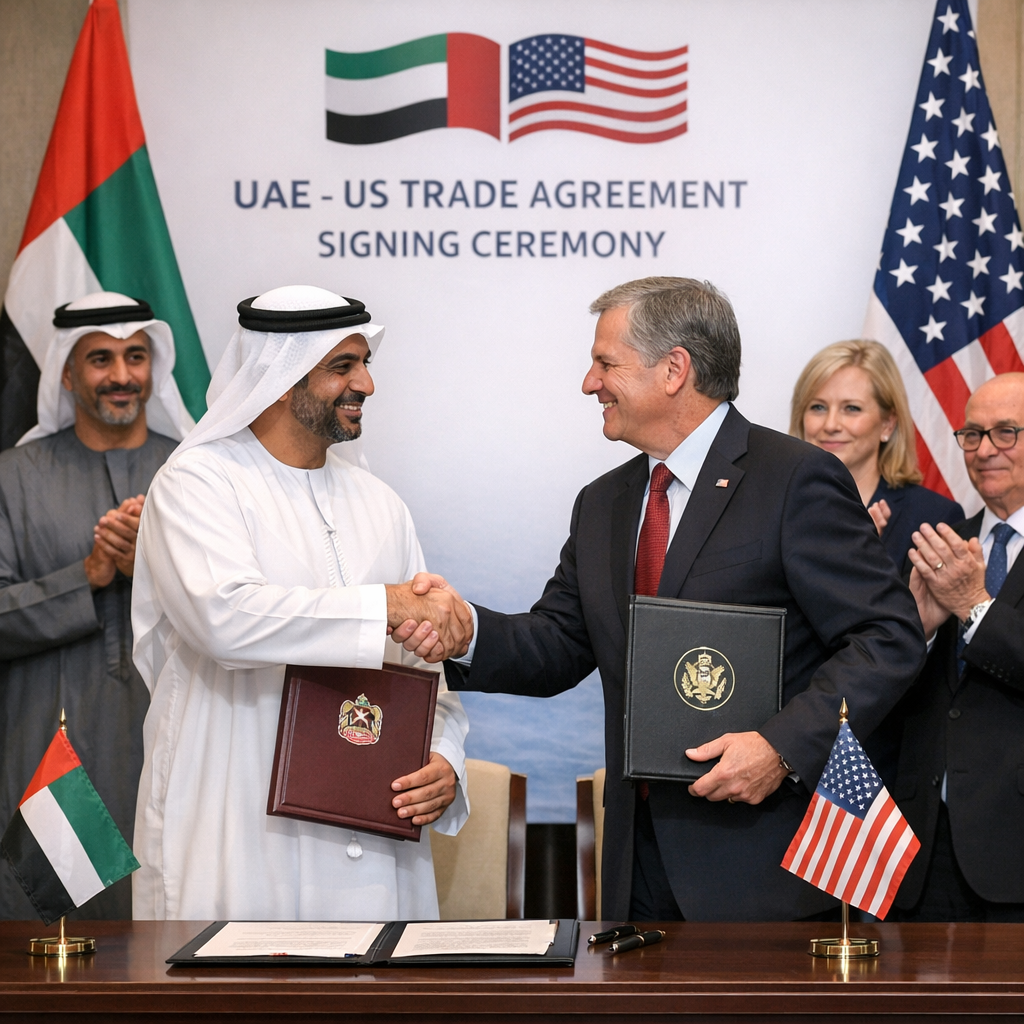
The economic relationship between the United Arab Emirates (UAE) and the United States has witnessed significant growth, underscoring the mutual commitment to fostering trade and investment. In 2025, bilateral trade reached a record $39 billion, marking a 13.3% increase from the previous year. This growth solidifies the UAE’s position as the United States’ top export destination in the Middle East and North Africa (MENA) region for the 17th consecutive year.
Record Trade Figures
According to data from the US Department of Commerce, US exports to the UAE totaled $31.4 billion in 2025, reflecting a 16.2% increase from 2024. This surge contributed to a US trade surplus of $23.8 billion with the UAE, the fourth largest globally. The UAE’s strategic investments in the US have also been substantial, exceeding $1 trillion, with plans to invest an additional $1.4 trillion over the next decade.
Strategic Investments and Collaborations
The partnership extends beyond trade, encompassing significant investments in technology and infrastructure. Microsoft announced a $15.2 billion investment in the UAE to expand artificial intelligence (AI) and cloud operations, aiming to deploy 81,900 Nvidia GPUs to power models from OpenAI, Anthropic, and Microsoft itself. This initiative aligns with the UAE’s commitment to becoming a global hub for AI and digital innovation.
Additionally, the US government granted Nvidia a license to export up to 500,000 advanced AI GPUs annually to the UAE, marking a substantial US-UAE tech partnership. These AI accelerators, primarily Nvidia’s Blackwell GPUs and future Rubin and Feynman chips, will be operated by American-managed data centers in the region, ensuring compliance with security and export control measures.
Economic Policy Dialogue
In January 2026, the United States and the UAE held their eleventh Economic Policy Dialogue in Abu Dhabi. The dialogue underscored the strategic importance of bilateral trade and investment, highlighting that the UAE is the largest US trade partner in the Gulf region, a distinction it has held for nearly two decades. Discussions focused on enhancing cooperation in AI, energy, and other key sectors, reflecting the shared commitment to economic growth and innovation.
The UAE’s decision to leave OPEC in April 2026 represents a major shift in global oil dynamics. Citing long-term strategic and economic goals, the move could align the UAE more closely with US energy policies, which seek increased oil production and lower prices. Analysts suggest that this decision reflects changing incentives in a world where oil demand is nearing its peak due to energy transition trends.
These developments highlight the deepening economic ties between the UAE and the United States, characterized by record trade figures, strategic investments, and collaborative initiatives across key sectors. The evolving partnership continues to drive mutual growth and innovation, benefiting both nations and contributing to global economic stability.