

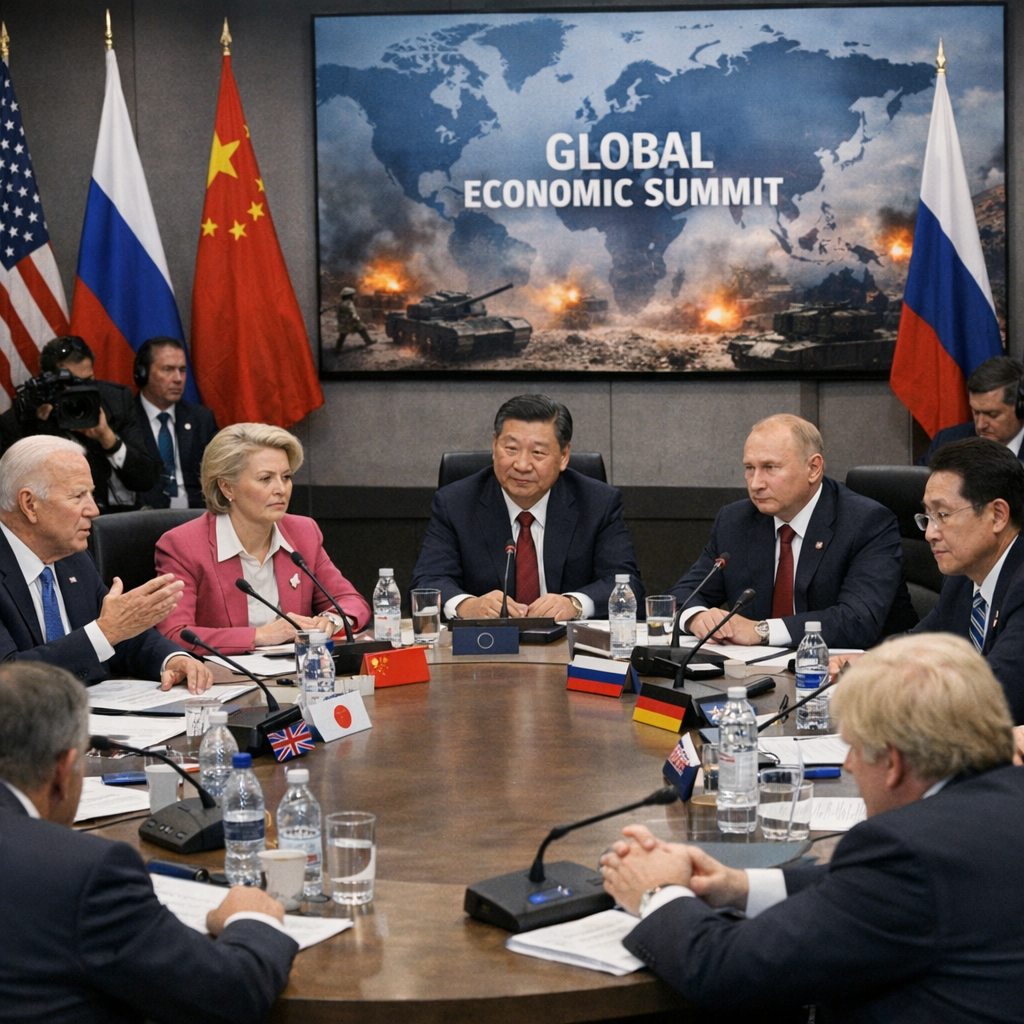
The global economic landscape is currently navigating a complex web of challenges, primarily driven by escalating geopolitical tensions in the Middle East. These conflicts have precipitated significant disruptions in energy supplies, leading to a surge in global inflation and a deceleration in economic growth.
Impact of Middle East Conflicts on Global Economy
The ongoing conflicts in the Middle East have led to substantial disruptions in energy production and trade, particularly affecting the Gulf economies. This has resulted in an energy shock that is driving inflationary pressures worldwide. The Organization for Economic Cooperation and Development (OECD) projects global growth to slow from 3.4% in 2025 to 2.8% in 2026, with a potential rebound to 3.1% in 2027, assuming a resolution to the conflicts. However, a prolonged disruption scenario could see global growth slowing further to 2.1% in 2026 and 1.8% in 2027.
Inflationary Pressures and Regional Impacts
Inflationary pressures are rising in both advanced and emerging market economies due to higher commodity prices and indirect effects on agricultural inputs and food. In the United States, GDP growth is projected at 2.0% in 2026, slowing to 1.8% in 2027. The euro area is expected to experience modest growth of 0.8% in 2026, picking up to 1.2% in 2027. China’s growth is projected to slow to 4.5% in 2026 and 4.3% in 2027.
Resilience Amidst Uncertainty
Despite these challenges, the global economy has shown resilience. The World Bank’s latest Global Economic Prospects report indicates that global growth is projected to remain broadly steady over the next two years, easing to 2.6% in 2026 before rising to 2.7% in 2027. This resilience reflects better-than-expected growth, especially in the United States, which accounts for about two-thirds of the upward revision to the forecast in 2026.
Policy Recommendations
To navigate these turbulent times, the OECD recommends that fiscal support provided by countries in response to the energy shock should be targeted towards those most in need and be temporary, to avoid a further increase in public debt and preserve incentives to save energy. Additionally, laying the foundations for stronger growth and productivity by improving the business environment, enhancing skills, and unlocking the benefits of AI and other transformative technologies is crucial.
In conclusion, while the global economy faces significant challenges due to geopolitical tensions and energy shocks, strategic policy measures and international cooperation can help mitigate these impacts and pave the way for a more stable economic future.