

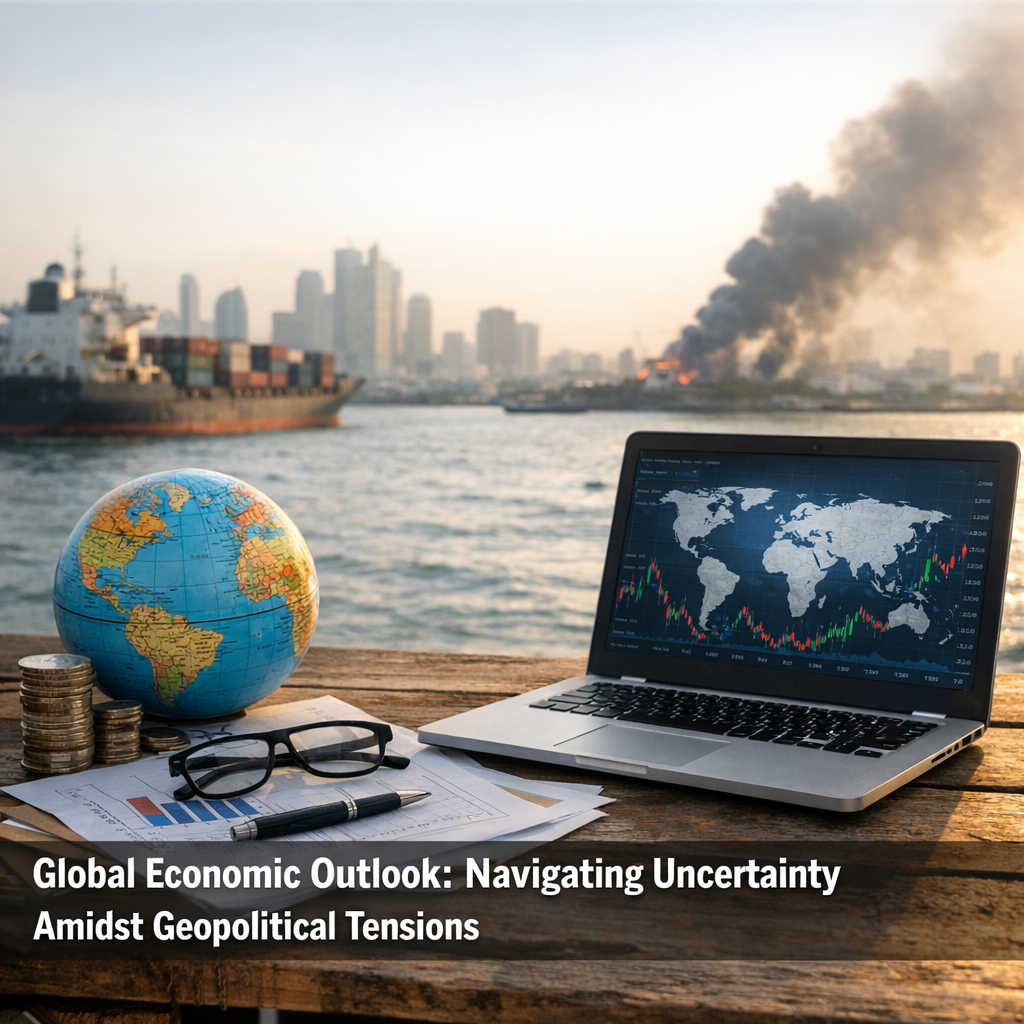
The global economy in 2026 is navigating a complex landscape shaped by geopolitical conflicts, technological advancements, and shifting trade dynamics. Recent projections indicate a slowdown in global growth, with the International Monetary Fund (IMF) revising its forecast down to 3% for the year, influenced by the economic repercussions of the Iran war and subsequent energy price surges.
Geopolitical Tensions and Energy Markets
The conflict in Iran has led to significant disruptions in global oil and gas supplies, notably due to the closure of the Strait of Hormuz. This has resulted in a nearly 32% increase in oil prices, contributing to stalled progress against inflation and impacting economies worldwide. The Organization for Economic Cooperation and Development (OECD) highlights that the global economy is being tested by these Middle East tensions, with growth projections adjusted accordingly.
Technological Advancements and Economic Resilience
Despite these challenges, technological advancements, particularly in artificial intelligence (AI), are providing some economic resilience. Increased investment in AI and related technologies is expected to bolster productivity and drive growth in various sectors. The World Economic Forum notes that surging AI investment is a defining trend for 2026, offering both opportunities and risks for the global economy.
Regional Economic Outlooks
Different regions are experiencing varied economic impacts:
- United States: The U.S. economy remains relatively resilient, with projections indicating a 2.1% growth rate. This is supported by strong domestic energy production and investments in AI, defense, and energy sectors.
- Europe: The eurozone faces slower growth, with forecasts around 0.9%, due to energy challenges and the broader impact of geopolitical tensions.
- Asia: India stands out with robust growth projections of 6.4%, driven by strong domestic demand. In contrast, China’s growth is expected to slow to 4.6%, influenced by property market issues but benefiting from infrastructure investment and tech exports.
Implications for the United Arab Emirates
For the United Arab Emirates (UAE), these global developments have significant implications. As a major player in the global energy market, the UAE is positioned to navigate the challenges posed by fluctuating oil prices and shifting trade dynamics. The country’s strategic investments in technology and infrastructure, coupled with its role as a regional trade hub, provide avenues to mitigate some of the adverse effects of global economic uncertainties.
In conclusion, while the global economic outlook for 2026 presents several challenges, including geopolitical tensions and energy market disruptions, opportunities exist through technological advancements and strategic regional positioning. For the UAE, leveraging its strengths in energy production and technological innovation will be key to sustaining economic resilience in this evolving global landscape.