

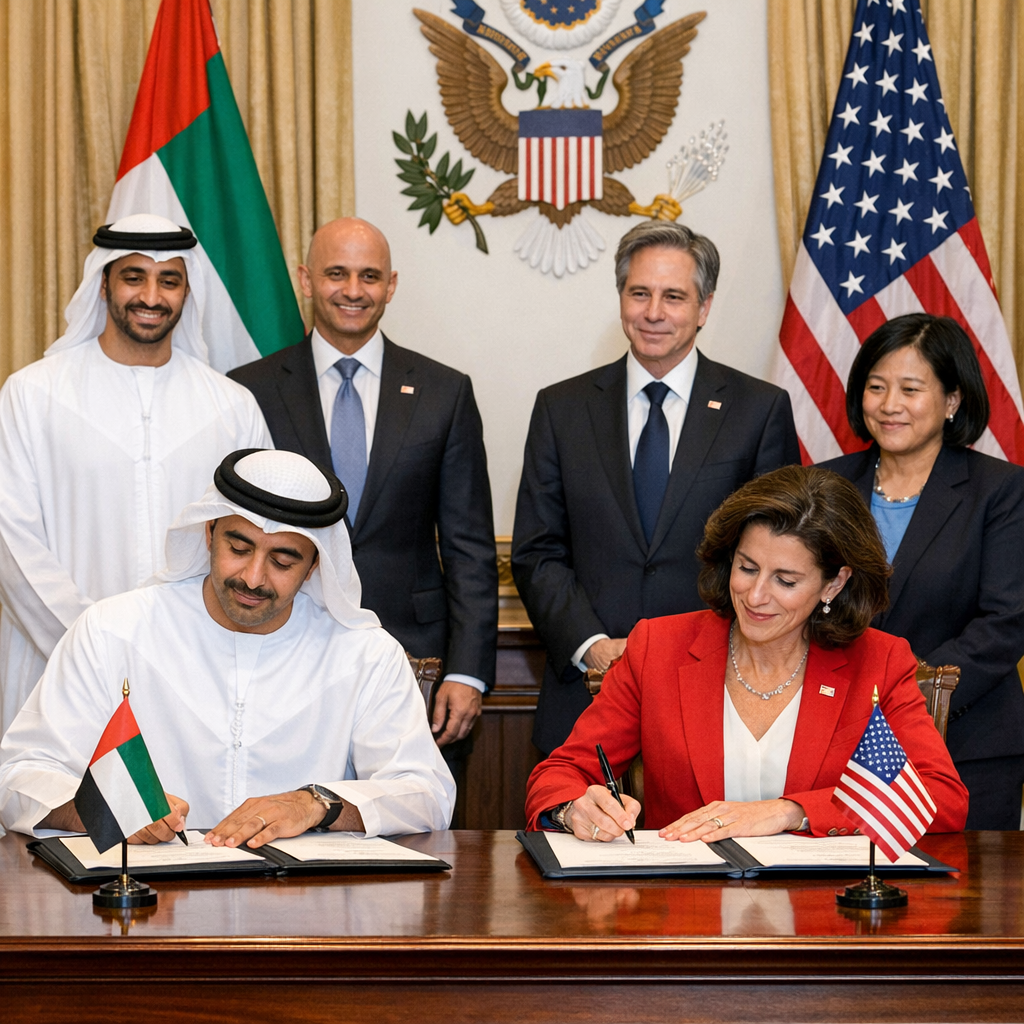
The United Arab Emirates (UAE) and the United States have long shared a robust economic partnership, characterized by mutual investments, trade agreements, and strategic collaborations. This relationship has seen significant growth in recent years, reflecting the shared commitment of both nations to fostering economic prosperity and technological advancement.
Record-Breaking Trade and Investment
In 2025, the bilateral trade between the UAE and the U.S. reached an unprecedented $39 billion, marking a 13.3% increase from the previous year. Notably, U.S. exports to the UAE totaled $31.4 billion, a 16.2% rise from 2024. This surge underscores the UAE’s position as the top export destination for U.S. goods in the Middle East and North Africa (MENA) region for the 17th consecutive year. The U.S. also recorded a $23.8 billion trade surplus with the UAE, the fourth largest globally. These figures highlight the deepening economic ties and the UAE’s significant role in supporting U.S. economic growth and job creation.
Strategic Investments in Technology and Defense
The partnership extends beyond trade, encompassing substantial investments in technology and defense sectors. The UAE has committed to investing an additional $1.4 trillion in the U.S. economy over the next decade, focusing on areas such as artificial intelligence (AI), advanced semiconductors, and space exploration. This commitment aligns with the UAE’s vision to be at the forefront of technological innovation and its strategic goal to diversify its economy.
In the defense sector, the U.S. Department of State approved a $16.5 billion arms deal to Gulf states, including the UAE, Kuwait, and Jordan. The deal encompasses the sale of drones, missiles, and radar systems, reflecting the shared strategic interests and priorities between the U.S. and the UAE.
Advancements in AI and Cloud Computing
Technological collaboration has been a cornerstone of the UAE-U.S. relationship. Microsoft announced a $15.2 billion investment in the UAE to expand AI and cloud operations. This initiative includes deploying 81,900 Nvidia GPUs to power models from OpenAI, Anthropic, and Microsoft itself. Additionally, Microsoft aims to train one million people in the UAE in AI-related skills by the end of 2027, further strengthening the technological capabilities of the region.
Furthermore, the U.S. Department of Commerce eased export controls on the UAE, facilitating the export of military items, AI chips, and commercial satellites. This move is expected to bolster the UAE’s technological infrastructure and enhance its capabilities in AI and defense technologies.
Implications for the Future
The deepening economic and strategic ties between the UAE and the U.S. signify a mutual commitment to fostering innovation, security, and economic growth. These collaborations not only strengthen bilateral relations but also contribute to regional stability and the advancement of global technological frontiers. As both nations continue to invest in key sectors, the partnership is poised to yield substantial benefits, driving progress and prosperity in the years to come.