

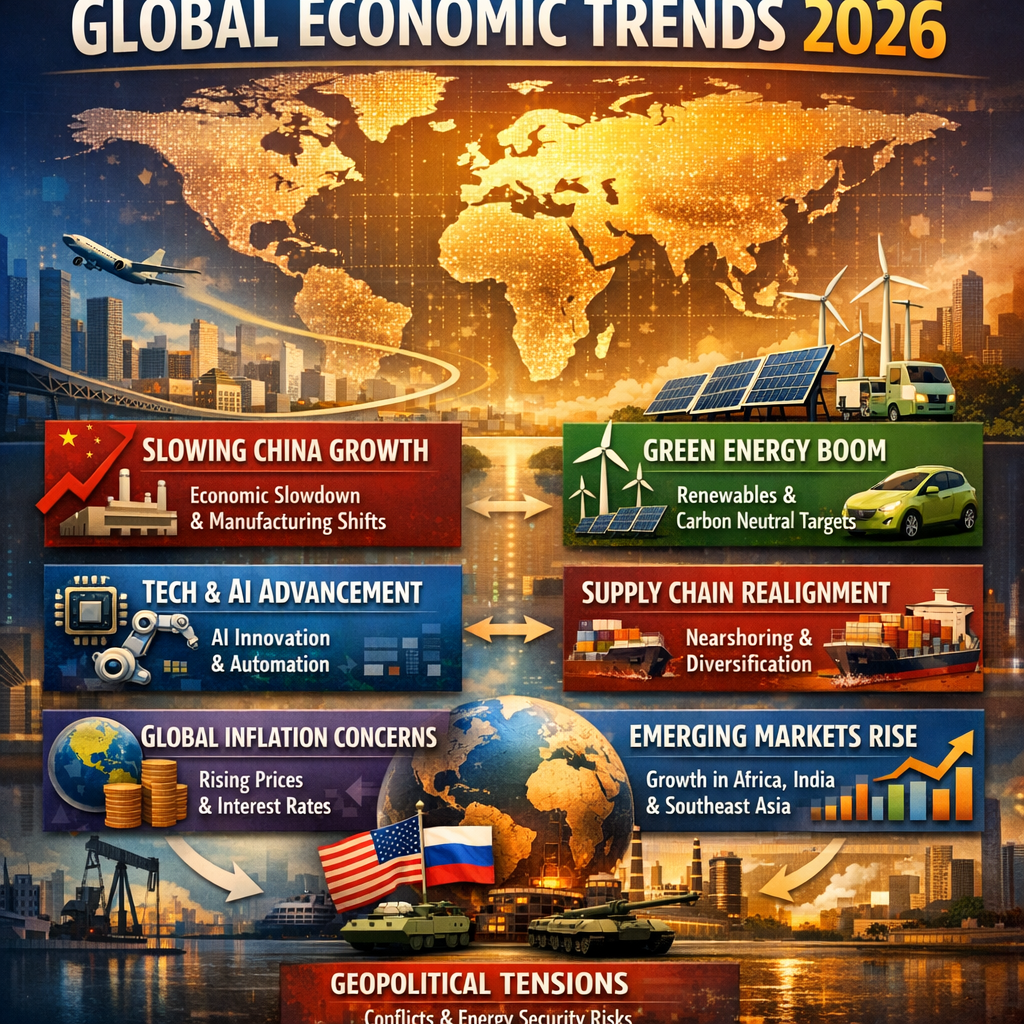
The global economic landscape in 2026 is characterized by a complex interplay of resilience and uncertainty. While technological advancements and strategic policy measures bolster growth, geopolitical tensions and energy crises present significant challenges.
Moderate Growth Amidst Challenges
Global GDP is projected to grow by approximately 2.8% in 2026, a slight decrease from 3% in 2025. This moderation reflects the impact of ongoing geopolitical conflicts, particularly in the Middle East, which have disrupted oil exports and contributed to rising commodity prices and inflation. Despite these challenges, the global economy has demonstrated resilience, with certain regions and sectors showing robust performance.
Regional Economic Dynamics
In the United States, the economy remains relatively resilient, supported by strong domestic energy production and significant investments in artificial intelligence (AI), defense, and energy sectors. These factors contribute to a projected GDP growth of 2.1% for 2026. However, consumers are exhibiting caution in spending due to rising inflation and unemployment rates.
Europe faces a more challenging economic environment, with the eurozone’s growth predicted at just 0.8%. Elevated energy costs have severely impacted industrial output, particularly in Germany and the United Kingdom, leading to stagflation—a combination of stagnant economic growth and high inflation.
In contrast, India stands out with a robust growth rate of 6.5%, driven by strong domestic demand and economic momentum. This positions India as a leading growth engine in the Asian region. Meanwhile, China’s growth is expected to slow to 4.5%, hindered by ongoing issues in the real estate sector, although gains in green technology and AI exports provide some offset.
Impact of the Energy Crisis
The energy crisis, exacerbated by conflicts in the Middle East, has led to significant disruptions in oil exports from the Persian Gulf. This situation has resulted in rising global inflation, projected to reach around 4.5%. The crisis underscores the global economy’s vulnerability to geopolitical events and the critical importance of energy security.
Technological Investments and Future Outlook
Despite these challenges, investments in AI and other technological advancements offer a silver lining. These investments are expected to drive productivity gains and support economic growth in the medium to long term. However, the immediate outlook remains cautious, with central banks likely to maintain current interest rates due to inflation concerns.
In summary, while the global economy in 2026 faces significant challenges from geopolitical tensions and energy crises, it also exhibits resilience through technological investments and policy adaptations. The path forward will require careful navigation of these uncertainties to sustain growth and stability.