

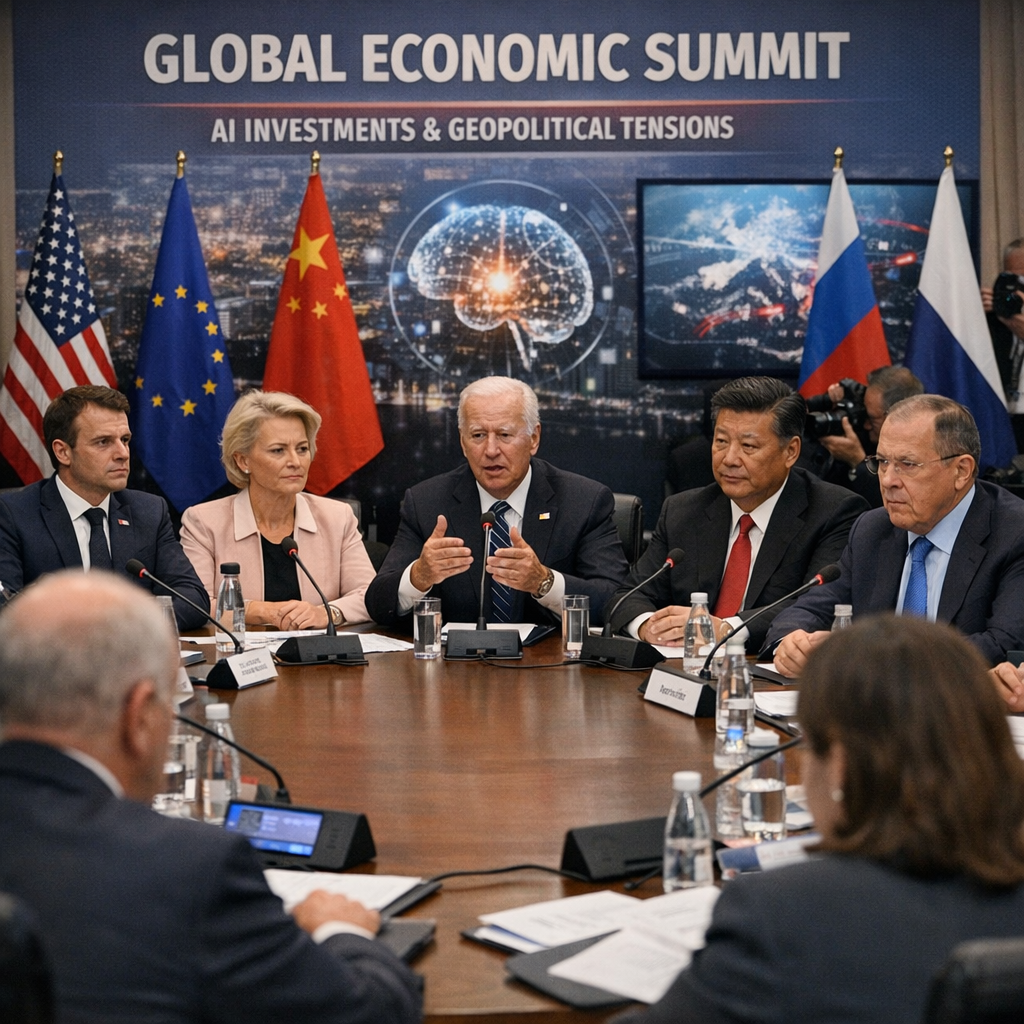
The global economy is currently experiencing a period of moderate growth, influenced by rapid technological advancements and ongoing geopolitical tensions. According to the International Monetary Fund (IMF), global growth is projected at 3.0% for 2026 and 3.4% for 2027, with artificial intelligence (AI) investments playing a significant role in this expansion.
Technological Investments Driving Growth
Major economies are channeling substantial resources into AI infrastructure. Gartner’s recent revision of its global IT spending forecast for 2026 anticipates a 14.2% annual increase to $6.37 trillion, primarily driven by AI-related investments. This surge is evident in sectors like data centers and Infrastructure as a Service (IaaS), which are expected to grow by 62.5% and 29.3%, respectively. Such investments are essential to support expanding AI workloads and high-performance computing demands.
Geopolitical Tensions and Economic Implications
Despite technological progress, geopolitical conflicts, particularly in the Middle East, pose challenges to global economic stability. The Organization for Economic Cooperation and Development (OECD) notes that while the global economy has shown resilience, recent conflicts have tested this robustness. The OECD projects global growth at 2.9% in 2026, with potential adjustments based on the evolving geopolitical landscape.
Regional Economic Perspectives
In the United States, consumer spending and AI-related capital expenditures are driving moderate growth. Kiplinger’s GDP Outlook reports a 1.5% growth in U.S. GDP for the second quarter of 2026, with consumer spending rising by 3.2% and business equipment investment surging by 15.2%, mainly due to AI-related chip purchases.
Conversely, the Eurozone faces challenges due to rising energy prices and geopolitical uncertainties. The OECD projects a slowdown in growth for the Eurozone, with a decline from 1.4% in 2025 to 0.8% in 2026, influenced by the impact of rising energy prices.
Inflation and Monetary Policies
Global disinflation trends have been interrupted by higher energy prices resulting from geopolitical conflicts. The IMF indicates that while inflation was moderating, recent energy price hikes have stalled this progress. Policymakers are now tasked with balancing the need to control inflation while supporting economic growth, a challenge compounded by the unpredictable nature of geopolitical events.
Conclusion
The global economic landscape is characterized by a delicate balance between technological advancements and geopolitical challenges. While investments in AI and related technologies offer promising avenues for growth, ongoing conflicts and their economic repercussions necessitate vigilant monitoring and adaptive policy measures. As nations navigate this complex environment, collaboration and strategic planning will be crucial in fostering sustainable economic development.