

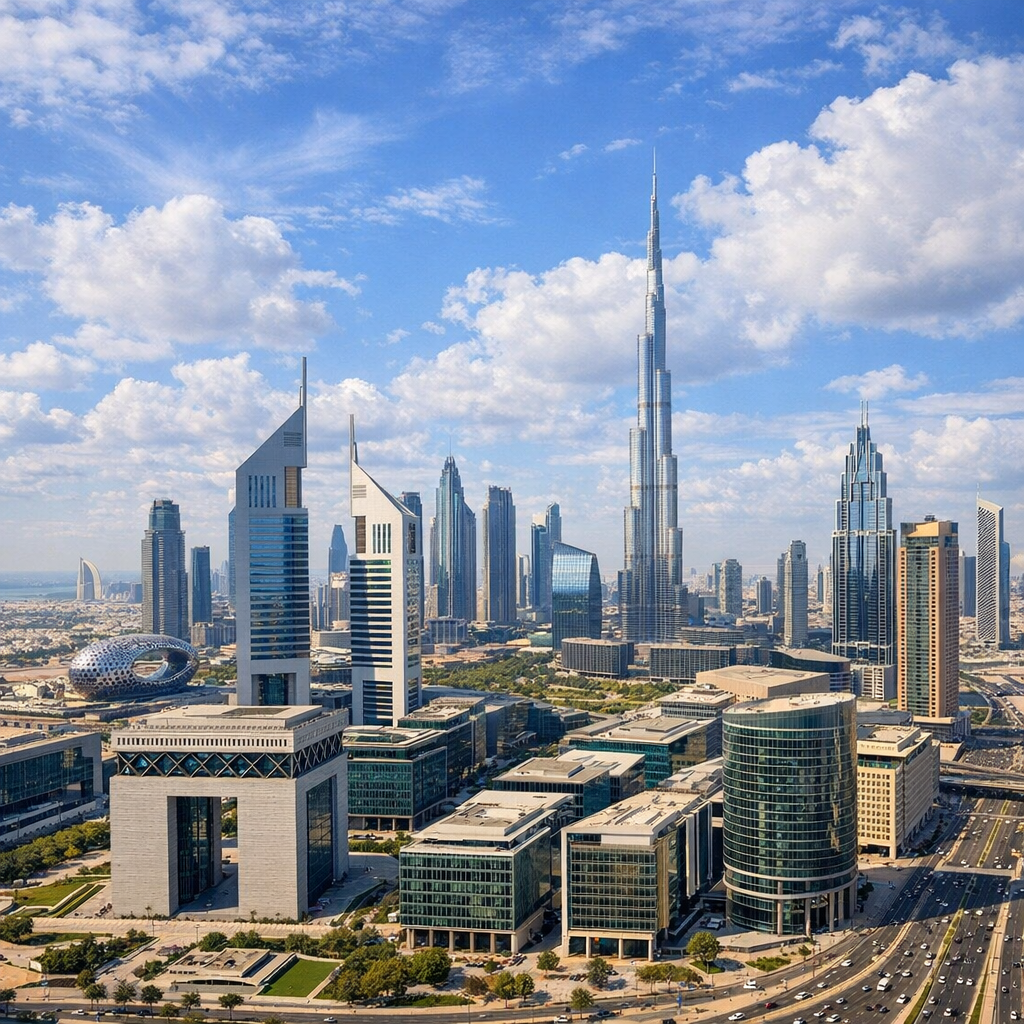
As the global economy undergoes significant transformations, Dubai’s financial sector stands at a pivotal juncture. Recent developments, including escalating tensions in the Persian Gulf and shifts in major economies, necessitate a closer examination of their potential repercussions on the emirate.
Global Economic Landscape
The International Monetary Fund’s July 2026 World Economic Outlook projects global growth at 3.0% for 2026 and 3.4% for 2027. This outlook is influenced by technological advancements, particularly in artificial intelligence, and geopolitical tensions affecting energy markets. Notably, the energy supply shock from the evolving conflict in the Middle East is testing the resilience of the global economy, with projections indicating a slowdown in growth and heightened inflationary pressures.
Regional Tensions and Dubai’s Financial Sector
Dubai’s financial sector is experiencing unease amid growing fears of prolonged conflict in the Persian Gulf. Despite apparent normalcy, the business milieu is increasingly impacted by missile threats, drone attacks, and political instability. The UAE government maintains strict control over public sentiment, promoting a narrative of security to preserve Dubai’s image as a stable financial hub. However, continued instability could result in an exodus of families and declining investor confidence, placing Dubai’s reputation and economic vibrancy at risk.
China’s Economic Slowdown
China’s economic momentum has declined, with minimal consumer spending growth and a deepening slump in investment. However, industrial production remains robust, highlighting an increasing gap between supply and demand. This disparity has intensified China’s reliance on foreign markets, posing risks to global trade relationships. Experts point out that this disconnect could heighten trade tensions, raising concerns about how much Chinese output global markets can realistically absorb.
Implications for Dubai
Dubai’s strategic position as a global trade and financial hub means that these global economic shifts have direct implications. The emirate’s reliance on international trade and investment necessitates a proactive approach to navigate these challenges. Diversifying economic partnerships, investing in emerging technologies, and reinforcing financial sector resilience are crucial steps to mitigate potential adverse effects.
In conclusion, while global economic trends present challenges, they also offer opportunities for Dubai to adapt and strengthen its position on the world stage. By staying informed and agile, the emirate can continue to thrive amidst the evolving global economic landscape.