

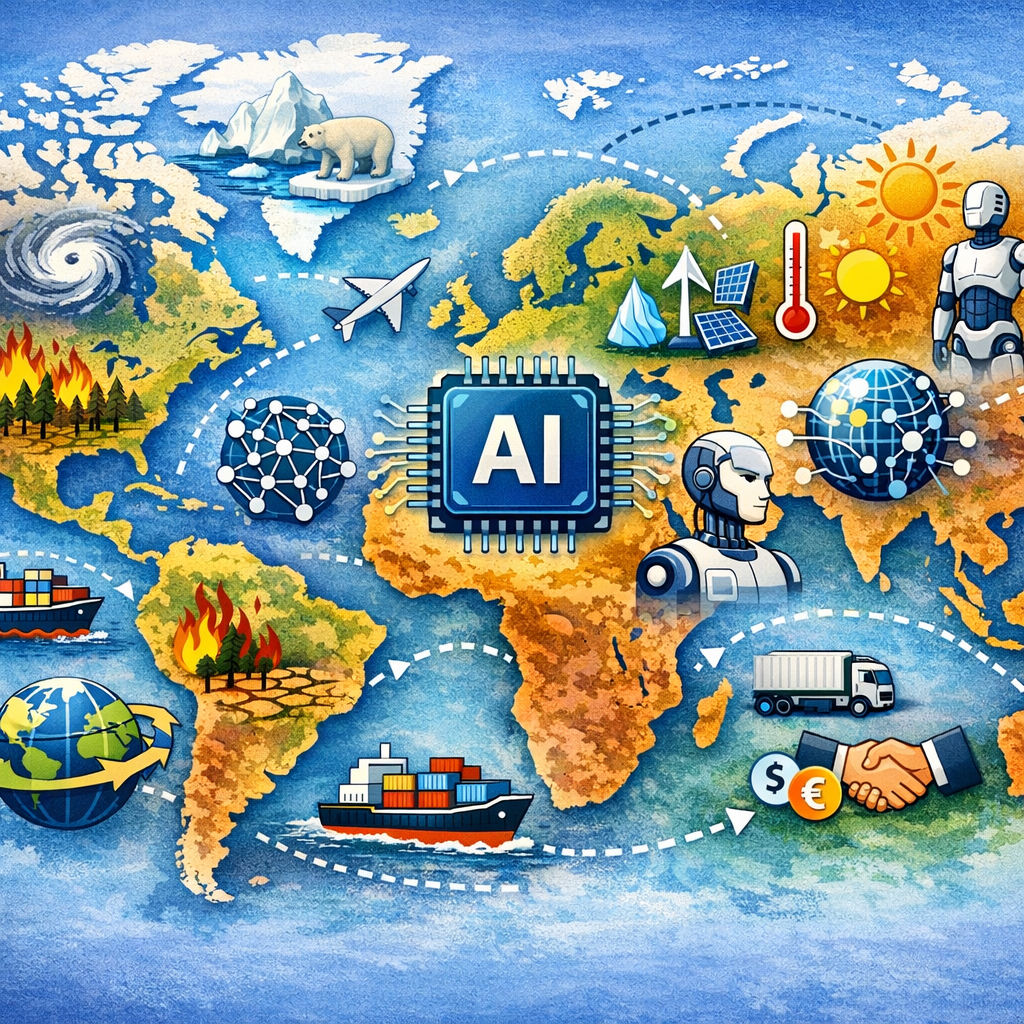
By Layla Al-Mansoori — Global interconnectedness has never been more central to international affairs. Three global currents in particular are defining urgent priorities for governments, businesses, and communities: adapting to climate change, regulating artificial intelligence, and strengthening supply chains in a volatile world.
Climate Adaptation: Moving from Plans to Action
Adaptation refers to the ways countries and communities adjust to climate stresses—whether that’s rising seas, increased heatwaves, or shifting rainfall patterns. It complements mitigation (efforts to reduce emissions), and is already critical because current warming has locked in many impacts. Effective adaptation spans strategies like flood defences, climate-smart agriculture, and resilient infrastructure. Yet globally, many gaps persist: in funding, in governance capacity, in access to timely information, and in ability to reach vulnerable populations. Adaptation must also be equitable, inclusive, and locally relevant or it risks reinforcing existing inequalities.
The Push for Meaningful AI Regulation
Artificial intelligence is accelerating in reach and capability—and with that comes rising debate about governance. More countries are introducing laws or frameworks that address AI safety, ethical use, and transparency. Yet differences in how regions approach regulation—whether via binding laws or softer voluntary standards—are creating a patchwork that complicates international cooperation. Among contested fronts are limiting harm in autonomous systems, ensuring human oversight in critical systems, and balancing innovation with oversight.
Strengthening Supply Chain Resilience
Recent global shocks—pandemics, geopolitical tensions, logistical bottlenecks—have exposed how fragile many supply chains are. Businesses are now placing great value on “resilience,” meaning capacity to adapt when disruptions strike. That often comes with hidden costs: reshoring or diversifying production increases expenses; added regulation or trade barriers can slow flows; and maintaining flexibility in sourcing demands constant investment. Policymakers face the task of enabling resilient trade without undercutting competitiveness.
Intersecting Paths & Global Implications
These three priorities—adaptation, AI regulation, and supply-chain resilience—are not isolated. Climate risks can disrupt trade routes; AI tools will be used both to predict climate impacts and manage logistics. Regulation in one area often influences progress in another, as data flows and infrastructure robustness become common concerns. Global institutions and local governments alike must collaborate.
What Can Be Done Now
Here are steps international actors but also communities can take:
- Invest in early warning systems and infrastructure built for future climate conditions.
- Support local voices and scientific data in climate planning, to ensure adaptation measures match specific needs.
- Develop AI regulatory frameworks that are principle-based, transparent, and socially accountable; engage stakeholders early.
- Foster international cooperation on AI standards—minimum safety norms, shared risk assessments, and ethical use.
- Build redundancies into supply chains—diversifying suppliers, exploring regional production hubs, and investing in logistics technology.
- Focus on living wages, just transitions, and policies that protect workers and ecosystems in times of change.
The challenges of our time are global, but the responses must be both global and deeply local. As Dubai’s community and, more broadly, the UAE engage with these issues—whether through sustainability efforts, tech innovation, or trade policy—they are part of shaping a world more prepared for uncertainty, complexity, and shared responsibility.