

By Layla Al-Mansoori
Why AI Governance Has Become a Global Imperative
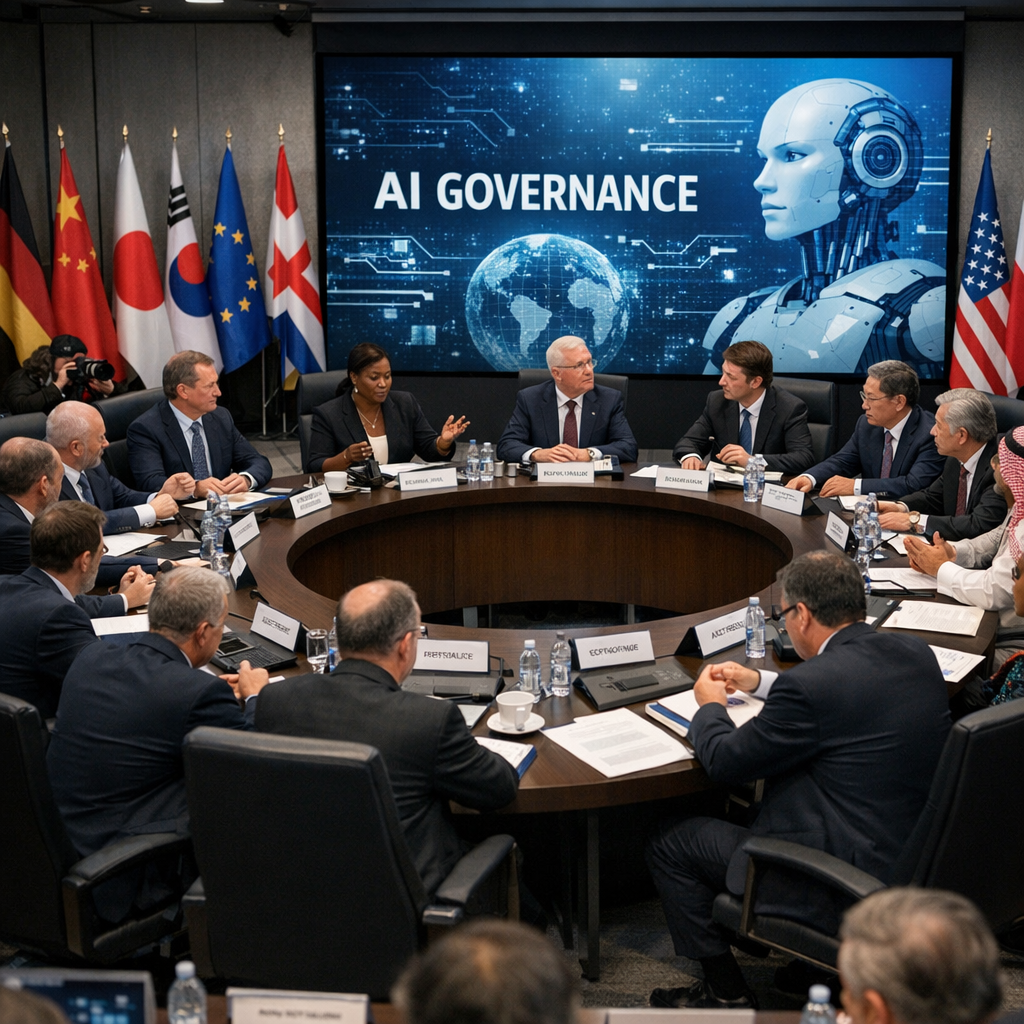
Across high-level United Nations forums, industry summits, and international diplomatic channels, leaders are increasingly ringing alarm bells about artificial intelligence. The risks posed by rapidly evolving AI systems—autonomous decision-making, misinformation, bias, security vulnerabilities—are now seen not just as technical challenges, but as urgent questions of global norms and ethics.
Calls for Global Standards
Executives from leading AI organizations recently addressed the UN Security Council, warning that existing safeguards are fraying under pressure. One central plea: coordinated international frameworks to test AI models, identify emerging risks, and establish consistent norms across borders. Another leadership proposal draws inspiration from institutes like the International Atomic Energy Agency, suggesting a similar entity for AI oversight might be needed. Without these common guardrails, the race to deploy advanced AI risks outpacing efforts to ensure safety and accountability.
Geopolitical Tensions Meet AI Strategy
The rise of competing AI governance models reflects broader geopolitical divides. Institutions like the newly formed World Artificial Intelligence Cooperation Organization (WAICO), led by China, emphasize engaging the Global South and crafting policies that balance technological access with strategic autonomy. Meanwhile, nations such as the US and members of the EU are also stepping up efforts, both in regulation and in strengthening oversight leadership roles. The result: a patchwork of regulatory experiments, some overlapping, others conflicting, waiting to be reconciled through cooperation.
Lessons From Other Global Crises
The urgency around AI governance mirrors other pressing challenges of forced displacement and climate change, where no single actor can succeed alone.
Forced Displacement: Numbers and Realities
By the end of 2025, roughly 117 million people worldwide were forcibly displaced due to conflict, persecution, or violence. That includes refugees, internally displaced persons, and asylum seekers. Despite a slight decrease in numbers for the first time in over a decade, the burden remains enormous—both on those fleeing and on the countries hosting them. Sustained, collaborative global responses are required not only for relief but for durable solutions.
Climate Action: The UAE Consensus
At COP led by the UAE, nations adopted what is known as the “UAE Consensus”—a set of ambitious global targets including tripling renewable energy, doubling energy efficiency, and scaling adaptation finance to meet evolving climate risks. This framework serves as a model of what can emerge when diverse stakeholders commit to shared outcomes, even amid sharp political and economic differences across countries.
Moving Forward: How Dubai and the UAE Can Engage
For Dubai and the UAE, being at the nexus of global innovation and diplomacy offers both responsibility and opportunity.
Championing Fair Global AI Participation
Ensuring that voices from the Middle East, Africa, and the wider Global South are included in AI governance forums will help ensure rules reflect diverse values and avoid perpetuating inequities. The UAE could help host international working groups or platforms where ethical frameworks are developed collaboratively.
Building Capacity at Home
Strong national oversight mechanisms—from independent audits to transparency requirements—can not only align the UAE with global expectations but also protect its own citizens and businesses as AI technologies become more widespread.
Conclusion
With AI no longer safely contained within labs or tech firms, its societal stakes are global. Displacement crises or climate change may dominate headlines, but the ethics, norms, and institutions governing AI may rapidly define the shape of the world to come. Cooperation isn’t optional—it’s essential.