

By Fatima Abdullah
Smart Services, Smoother Experiences
In Dubai today, technology isn’t a backdrop—it’s part of nearly every interaction. One of the most visible changes is seen in how government services work. Thanks to recent directives, all individual and business services will be unified under a single digital platform, powered by AI and data integration to reduce friction and increase efficiency. These systems are being designed to “see, think, and act” to respond rapidly to things like traffic issues, emergency alerts, or service performance monitoring.
For example, applying for residency, renewing licenses, or scheduling appointments often now happens through apps that incorporate generative AI or autonomous agents. In many cases, what once took hours is now handled in minutes—or even seconds.
AI Where You Least Expect It
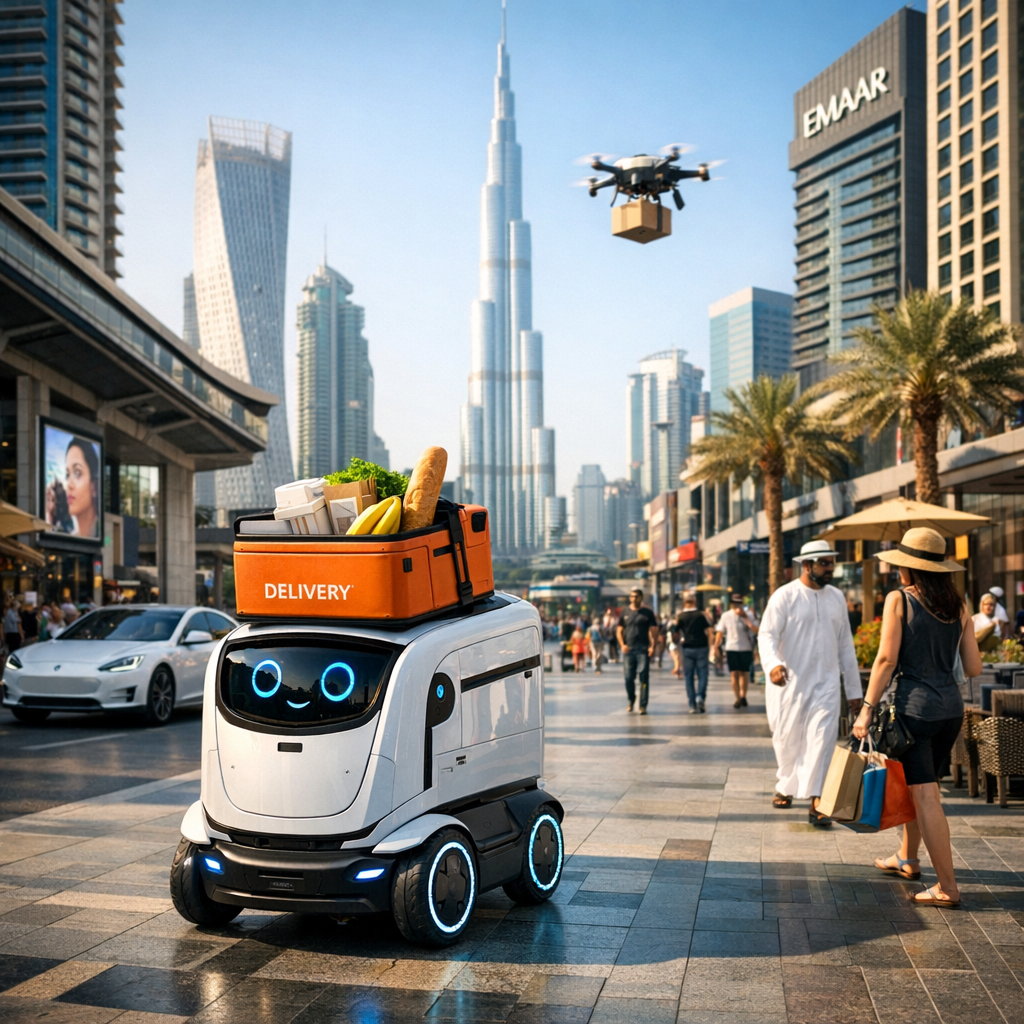
AI has entered many parts of daily life you might not always notice. Pavement robots are delivering meals in some residential areas. Biometric gates at Dubai International Airport can let you pass through in just a few seconds. Even corporate wellness programs are using AI dashboards—tracking health metrics, predicting risks, nudging behaviour to reduce sick leave.
Startups Building Real Change
Startups in the UAE aren’t just chasing hype. They’re working on hard tech: climate, biotech, XR (extended reality), and infrastructure. Some are developing smart contact lenses to integrate XR, night vision, health monitoring. Others are using autonomous robotics to restore ecosystems or building AI systems to offer trusted services without manual oversight.
Gadgets That Fit Your Routine
On the consumer side, “smart” gadgets are now tailored to local needs. People are buying foldable phones, AI-powered smartphones with built-in translation and photo editing tools, wearables that monitor wellness, and earbuds that adapt to your environment. When choosing a gadget, it’s increasingly important it works with regional networks and has dependable local service.
Trade-Offs and What to Watch For
These advances come with trade-offs. Data privacy and transparency are front of mind: when AI is automating decisions about licenses or wellness rewards, people want to know how it works. There’s also concern over whose oversight ensures these systems are fair and reliable. As these technologies become more embedded, regulation and trust become just as important as innovation.
The Road Ahead
Dubai’s leadership has committed to scaling up agentic AI—autonomous agents that carry out tasks based on natural conversation—with many services expected to move in this direction. Infrastructure is improving, and hardware is catching up. For residents, that means more frictionless travel, smarter homes, convenient healthcare, and a more responsive city.
If you pay attention, you’ll already see AI at work—from your phone to the pavement. What comes next is figuring out how to make it serve everyone, transparently and thoughtfully.