

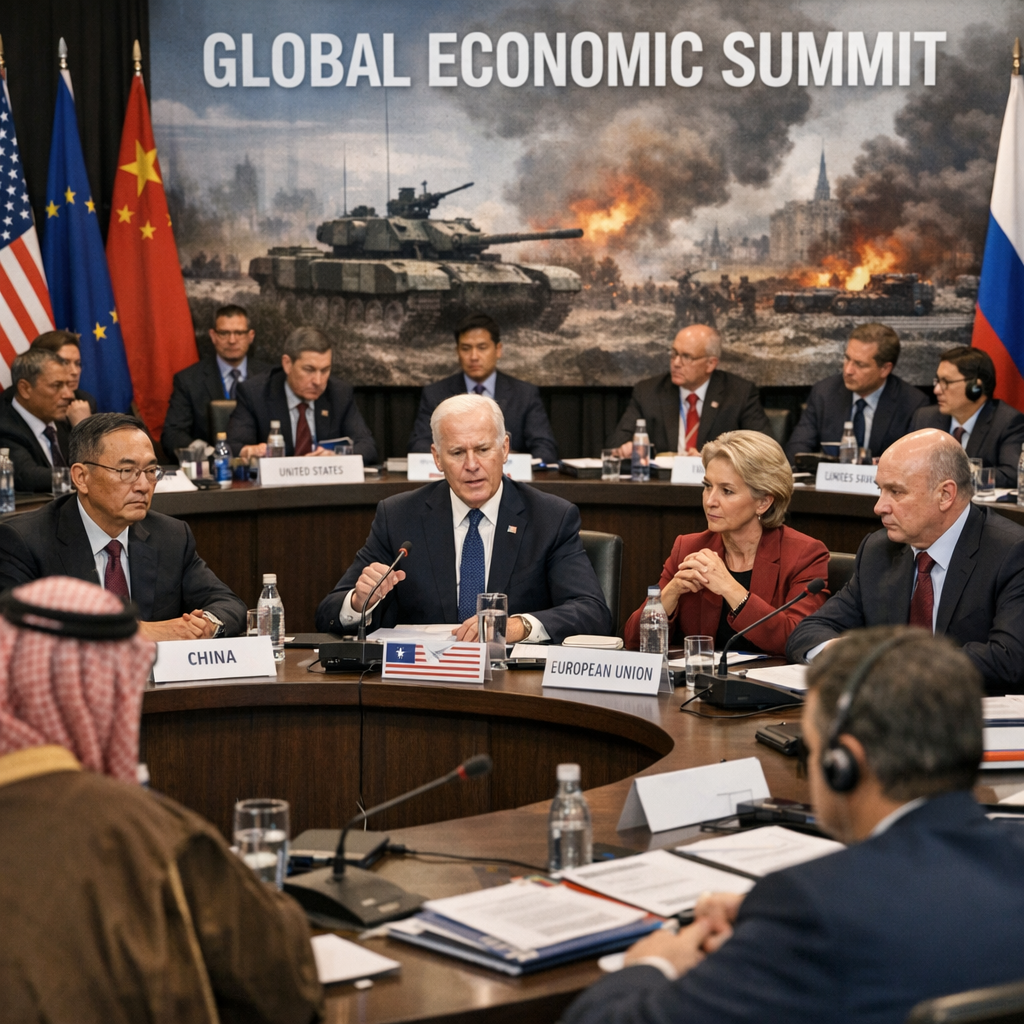
The global economic landscape is currently navigating a complex array of challenges, primarily driven by escalating geopolitical tensions in the Middle East. These developments have introduced significant uncertainties, particularly concerning energy supplies, which are crucial for economies worldwide.
Impact of Middle East Conflicts on Global Growth
Recent conflicts in the Middle East have led to disruptions in energy production and trade, resulting in an energy shock that is influencing global economic projections. The Organization for Economic Cooperation and Development (OECD) has highlighted that these disruptions are testing the resilience of the global economy. In its latest Economic Outlook, the OECD projects global growth to slow to 2.8% in 2026, down from 3.4% in 2025, before a modest recovery to 3.1% in 2027. This slowdown is attributed to the ongoing energy supply challenges and the broader uncertainties stemming from the Middle East conflicts.
Regional Economic Projections
The impact of these geopolitical tensions varies across regions. In the United States, growth is projected at 2.0% in 2026, with a slight decrease to 1.8% in 2027. The euro area is expected to experience modest growth of 0.8% in 2026, improving to 1.2% in 2027. China’s growth is anticipated to slow to 4.5% in 2026 and 4.3% in 2027. These projections underscore the widespread influence of Middle East conflicts on global economic performance.
Inflationary Pressures and Policy Responses
The energy shock has also led to rising inflationary pressures. The OECD forecasts that inflation in G20 countries will reach 4.0% in 2026, up from 3.4% in 2025, before easing to 3.1% in 2027. This inflationary trend is prompting central banks to reassess monetary policies. For instance, the Federal Reserve in the United States may consider rate cuts to stimulate growth, while the European Central Bank is likely to maintain stable rates to manage inflation.
Implications for the United Arab Emirates
For the United Arab Emirates (UAE), these global economic dynamics present both challenges and opportunities. As a major energy producer, the UAE could benefit from higher energy prices. However, the broader economic slowdown and inflationary pressures may impact trade and investment flows. It is crucial for the UAE to continue diversifying its economy and strengthening non-oil sectors to enhance resilience against external shocks.
In conclusion, the global economy is at a pivotal juncture, with geopolitical tensions in the Middle East playing a significant role in shaping economic trajectories. Policymakers worldwide must navigate these uncertainties carefully, balancing measures to control inflation with strategies to sustain growth. For the UAE, proactive economic diversification and strategic planning will be key to mitigating the impacts of these global challenges.