

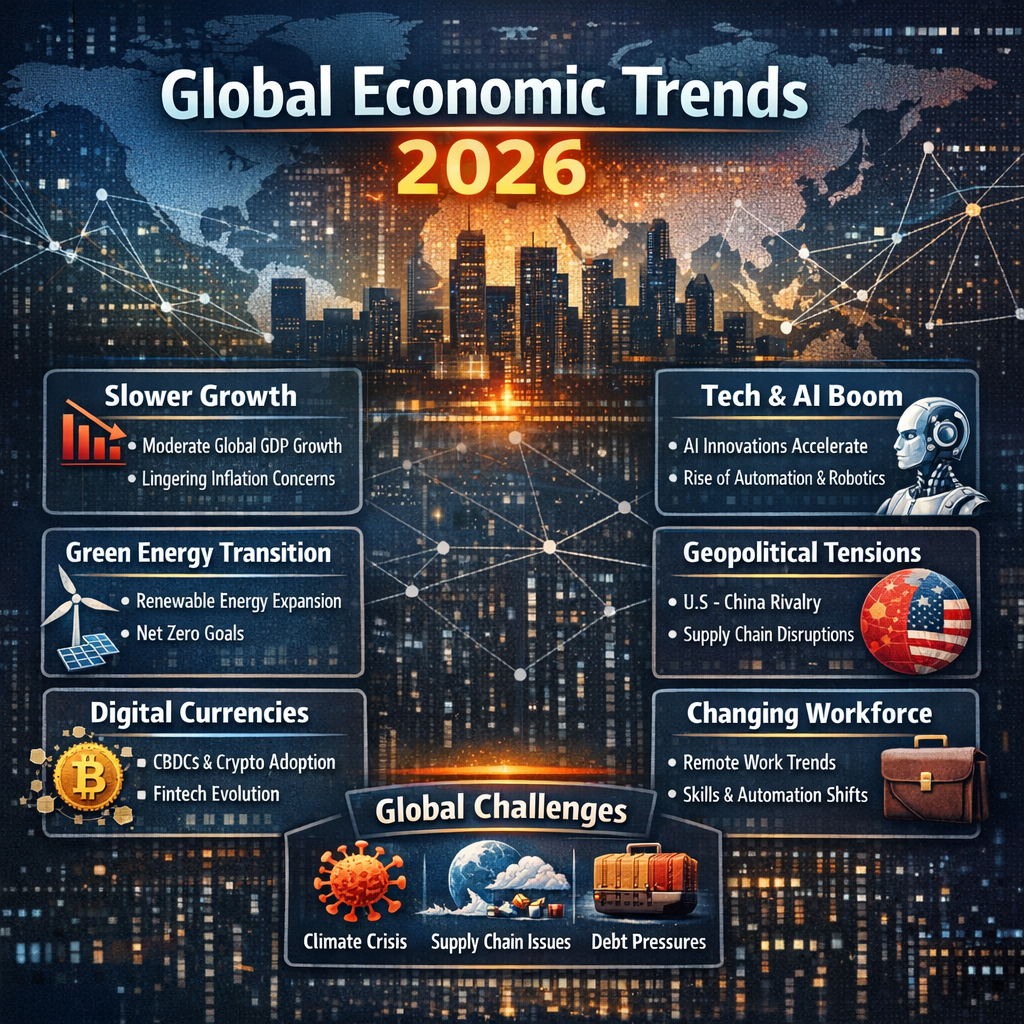
The global economy is currently navigating a complex landscape marked by energy disruptions and significant policy shifts. According to the Organisation for Economic Co-operation and Development (OECD), global growth is projected to slow to 2.7% in 2026, down from 3.4% in 2025. This deceleration is attributed to energy shocks stemming from Middle East conflicts and rising inflationary pressures.
Energy Crisis and Inflation
The ongoing conflict in the Middle East has led to substantial disruptions in energy production and trade, particularly affecting Gulf economies. This has resulted in an energy shock that is driving inflationary pressures worldwide. The OECD outlines two scenarios: a time-limited disruption where energy markets stabilize by mid-2026, and a prolonged disruption extending into 2027, which could have more severe and lasting impacts on global growth.
Policy Shifts and Economic Strategies
In response to these challenges, various nations are reevaluating their economic policies. In the United States, Treasury Secretary Scott Bessent introduced “Trumponomics 2.0,” emphasizing reshoring manufacturing and imposing tariffs to reduce reliance on foreign goods. This marks a significant departure from traditional globalization models, aiming to bolster economic independence.
Regional Economic Performances
Despite global tensions, certain regions are demonstrating resilience. The United States is projected to maintain a steady growth rate of 2.0% in 2026, supported by robust consumer spending and investments in artificial intelligence. Conversely, the euro area faces modest growth, with projections at 0.8% for 2026, as energy costs and geopolitical uncertainties weigh on industrial output.
Emerging economies present a mixed picture. India stands out with a projected growth rate of 6.5% in 2026, driven by strong domestic demand and structural reforms. China, however, is expected to experience a slowdown, with growth projected at 4.5%, influenced by real estate challenges and shifts in global trade dynamics.
Implications for the Middle East
For the Middle East, particularly the United Arab Emirates, these global developments carry significant implications. The region’s economic performance is closely tied to energy markets and global trade. Diversification efforts and strategic investments in non-oil sectors are crucial to mitigate the impacts of global energy shocks and policy shifts.
In conclusion, the global economic outlook for 2026 is characterized by uncertainty and the need for adaptive strategies. Nations and regions must navigate these challenges through policy adjustments, economic diversification, and international cooperation to foster resilience and sustainable growth.