

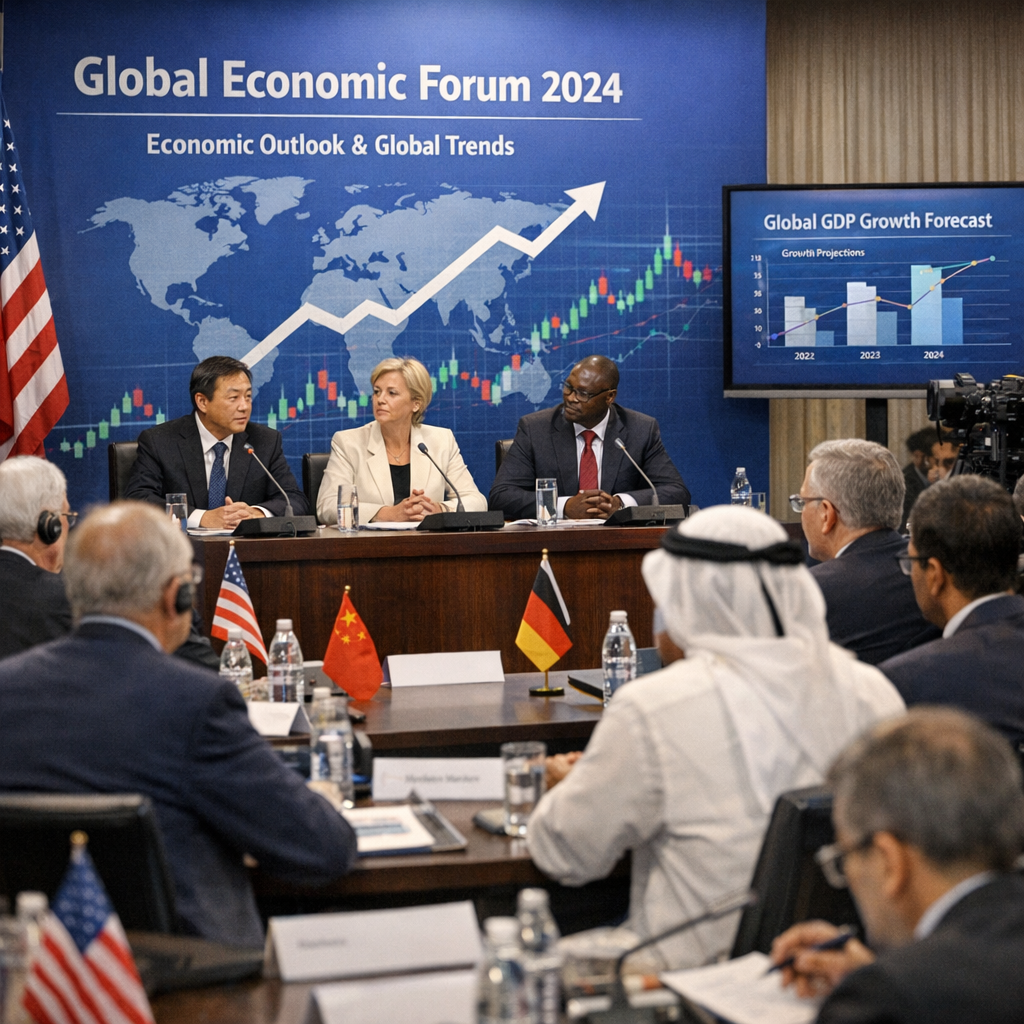
The global economy is currently navigating a complex landscape marked by geopolitical tensions, energy shocks, and inflationary pressures. Recent conflicts in the Middle East have significantly impacted global economic prospects, leading to a reassessment of growth projections and policy strategies.
Impact of Middle East Conflicts on Global Growth
The ongoing conflict in the Middle East has emerged as a dominant force shaping global economic prospects. This situation has prompted an energy shock, driving inflationary pressures and adversely affecting growth. The Organization for Economic Cooperation and Development (OECD) has outlined two scenarios: a time-limited disruption and a prolonged disruption. In the time-limited scenario, global growth is projected to slow from 3.4% in 2025 to 2.8% in 2026, before picking up to 3.1% in 2027. In the prolonged disruption scenario, global growth could slow to 2.1% in 2026 and 1.8% in 2027, with more lasting consequences for the global economy.
Regional Economic Projections
Different regions are experiencing varied economic impacts:
- United States: Growth is projected at 2.0% in 2026, slowing to 1.8% in 2027, influenced by a slowdown in consumption due to declining purchasing power and labor force.
- Eurozone: Growth is expected to remain modest at 0.8% in 2026, picking up to 1.2% in 2027, affected by rising energy prices and external factors such as stronger currencies and tariffs on exports.
- China: Growth is projected to slow to 4.5% in 2026 and 4.3% in 2027, as the export strength of 2025 loses momentum, placing more emphasis on domestic demand to support growth.
Inflationary Pressures and Policy Responses
Inflationary pressures are rising in both advanced and emerging market economies. The energy shock is leading to higher commodity prices, while indirect effects are boosting prices across the economy, notably for agricultural inputs and food. In the time-limited disruption scenario, annual consumer price inflation in the G20 economies is collectively expected to rise to 4.0% in 2026, from 3.4% in 2025, before easing to 3.1% in 2027 as energy and food price pressures fade.
Implications for Dubai and the UAE
For Dubai and the broader United Arab Emirates, these global economic trends have significant implications. As a major hub for trade and finance, the UAE’s economy is closely linked to global markets. The energy shock and rising inflation could impact key sectors such as tourism, real estate, and trade. However, the UAE’s strategic initiatives to diversify its economy and invest in sectors like technology and renewable energy may help mitigate some of these challenges.
In conclusion, while the global economic outlook presents several challenges, particularly due to geopolitical tensions and energy shocks, strategic policy responses and economic diversification efforts can help navigate this uncertain landscape.