

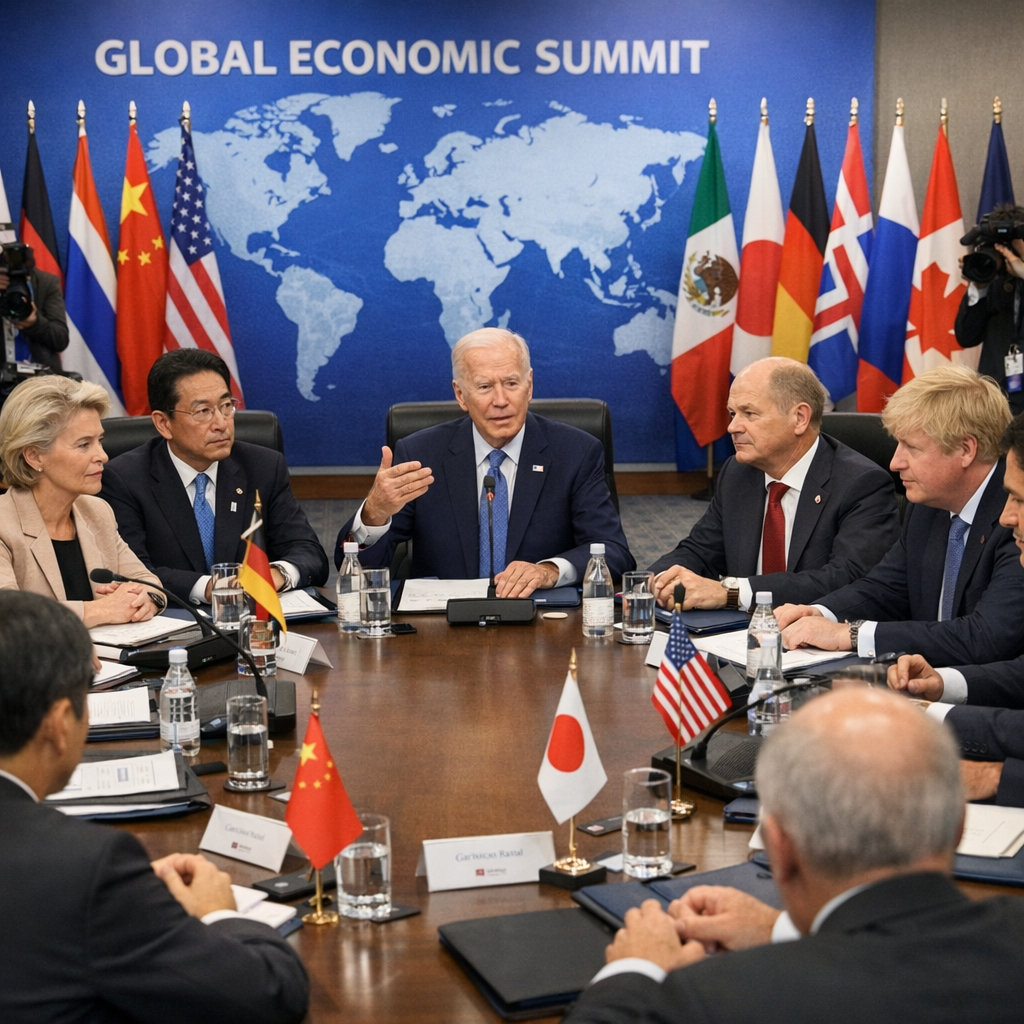
The global economy is currently navigating a complex landscape marked by geopolitical tensions, energy crises, and technological advancements. Despite these challenges, projections indicate a moderate growth trajectory, underscoring the resilience of global markets.
Current Economic Projections
According to the World Bank’s latest Global Economic Prospects report, global growth is projected to remain steady over the next two years, easing to 2.6% in 2026 before rising to 2.7% in 2027. This resilience reflects better-than-expected growth, especially in the United States, which accounts for about two-thirds of the upward revision to the forecast in 2026. However, if these forecasts hold, the 2020s are on track to be the weakest decade for global growth since the 1960s.
Impact of Geopolitical Tensions
Recent conflicts in the Middle East have introduced significant volatility into global markets. The Organization for Economic Cooperation and Development (OECD) notes that the global economy, which had shown robustness, is now facing a test of its resilience due to these intensified conflicts. The OECD projected global growth at 2.9% in 2026, unchanged from the December 2025 forecast, and 3.0% in 2027, down 0.1 percentage points from the December 2025 forecast. The OECD highlighted that while there was a possibility of adjusting the global growth rate upward by 0.3 percentage points from the December forecast, this was entirely offset by the intensifying conflict in the Middle East.
Technological Advancements and Economic Growth
On a positive note, investments in artificial intelligence (AI) and other technological innovations are contributing to economic resilience. Morgan Stanley’s midyear economic outlook highlights that the global economy continues to expand, supported by momentum in the U.S., where investments related to AI and spending by wealthier consumers are boosting growth. Global growth is likely to slow modestly to 3.2% for the full year, hurt by the energy shock but avoiding recession, and then recover to 3.4% in 2027 as oil and gas prices ease.
Regional Perspectives
In the United States, consumer spending and capital expenditures on AI are likely to drive moderate growth as global inflation slows. Annual global economic growth may moderate to 3% in 2025 and 3.2% in 2026, before stabilizing in 2027, helped by resilient consumption and capital spending. With inflation continuing to moderate in most major economies, monetary policymakers in the U.S., UK, and eurozone have room to cut rates.
Europe, however, faces slower growth, with the eurozone projected to grow at just 0.8% in 2026, as energy costs severely impact industrial output, especially in Germany and the UK. In contrast, India stands out with a projected growth of 6.5%, driven by strong domestic momentum, while China’s growth is expected to slow to 4.5% amid ongoing real estate issues but gains in green-tech and AI exports.
Conclusion
While the global economy faces significant challenges, including geopolitical tensions and energy crises, its underlying resilience, bolstered by technological advancements and strategic investments, offers a cautiously optimistic outlook. Policymakers and businesses must navigate these uncertainties with informed strategies to sustain growth and stability.