

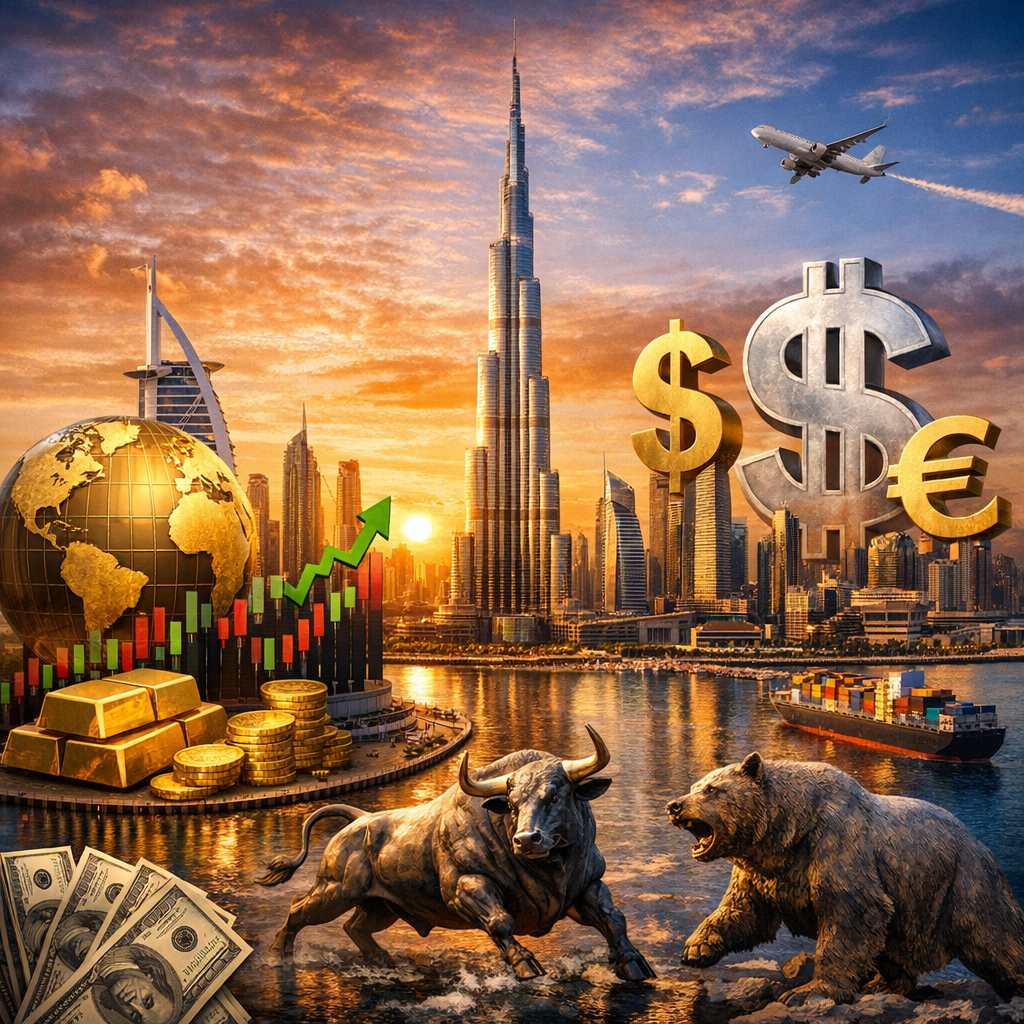
The global economy is currently navigating a complex landscape marked by geopolitical tensions, energy crises, and shifting trade dynamics. These developments have far-reaching implications, including for Dubai, a city deeply integrated into the global economic fabric.
Global Economic Overview
Recent conflicts in the Middle East have led to significant disruptions in oil exports, particularly from the Persian Gulf. This has resulted in rising commodity prices and global inflation, projected to reach around 4.5%. Despite advancements in artificial intelligence and other technologies, global growth is forecasted to slow to 2.8% in 2026. The United States shows resilience with a projected GDP growth of 2.1%, while Europe faces stagflation, with eurozone growth predicted at just 0.8%. China and India present contrasting pictures, with China slowing to 4.5% growth amid real estate challenges, and India standing out with a robust 6.5% growth driven by strong domestic momentum.
Implications for Dubai
Dubai’s economy is intricately linked to global markets, making it susceptible to these international trends. The energy crisis and rising inflation could impact key sectors such as tourism, trade, and real estate. However, Dubai’s strategic initiatives in diversifying its economy, investing in technology, and enhancing its position as a global business hub may help mitigate some of these challenges. The city’s proactive approach to economic diversification and its strategic location continue to position it as a resilient player in the global economy.
Conclusion
While global economic trends present challenges, Dubai’s adaptive strategies and economic policies aim to navigate these complexities effectively. Continuous monitoring of international developments and agile policy responses will be crucial in sustaining Dubai’s economic growth and stability.