

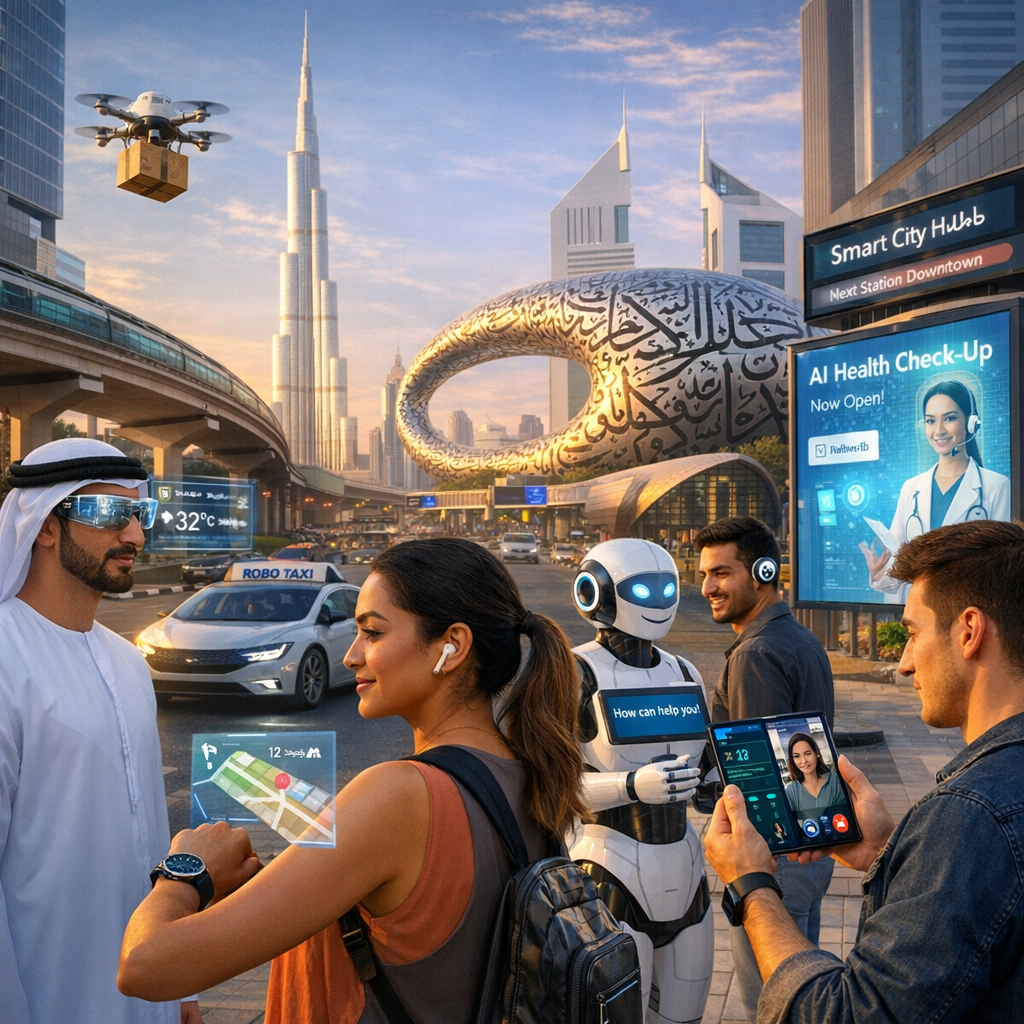
Dubai has long aimed to be a global innovation hub. Lately, that goal feels less distant as artificial intelligence, startups, and new gadgets move from futuristic promise into the routines of daily living. Here’s how tech is subtly but steadily changing the city—and what residents should expect next.
AI Behind the Scenes
Take government services: chatbots are now the default way to renew a visa, pay a fine, or access customer support without ever stepping foot in a service center. Thanks to Dubai’s National Digital Transformation Program, these conversational interfaces are saving time for both residents and public agencies.
In mobility and delivery, autonomous robots on residential walkways are no longer just pilot projects—they’re active in areas like Sobha Hartland. Cities are also employing AI to predict traffic flows and adjust public transport routes in real time to reduce congestion.
Startups Solving Real Problems
Dubai’s ecosystem is pushing past hype. Deep tech startups are designing home-grown products with practical applications: wearables that monitor health, robotics for sustainability, and even smart contact lenses designed for extended-reality experiences.
Innovation hubs and funding sources—such as public tech labs and startup accelerators—help early-stage founders turn prototypes into scalable solutions. Local talent is being trained not just to use AI, but to lead projects and build systems that operate at city scale.
Gadgets Making Lives Smoother
Smart home devices—though adoption still lags compared to smartphones—are increasing in popularity. From voice-controlled lighting to AI-based tools that manage energy use, these gadgets reduce manual effort and help stretch budgets.
Wearable tech like smartwatches and health trackers are increasingly common. They not only log sleep, heart rate or steps, but also offer real-time feedback and suggestions for improving wellbeing. Residents are using them as tools to proactively monitor health and stress amidst busy lifestyles.
Challenges & What Comes Next
With AI agents woven into so many touchpoints—home, work, government—questions about privacy, data security, and accountability grow louder. There’s also a learning curve: some people worry generative AI tools make decisions for them without sufficient transparency.
From here, the next phase will likely include more offline AI (so tools work even without constant connectivity), more inclusive designs (language, cultural nuances), and broader deployment of advanced tech in infrastructure and healthcare. The goal: to embed tech so naturally it feels invisible.
As Dubai reimagines what daily life looks like, the tech ecosystem doesn’t just add novelty—it changes possibilities. What used to feel like tomorrow is now unfolding today—and for many, quietly making life a little smarter and smoother.