

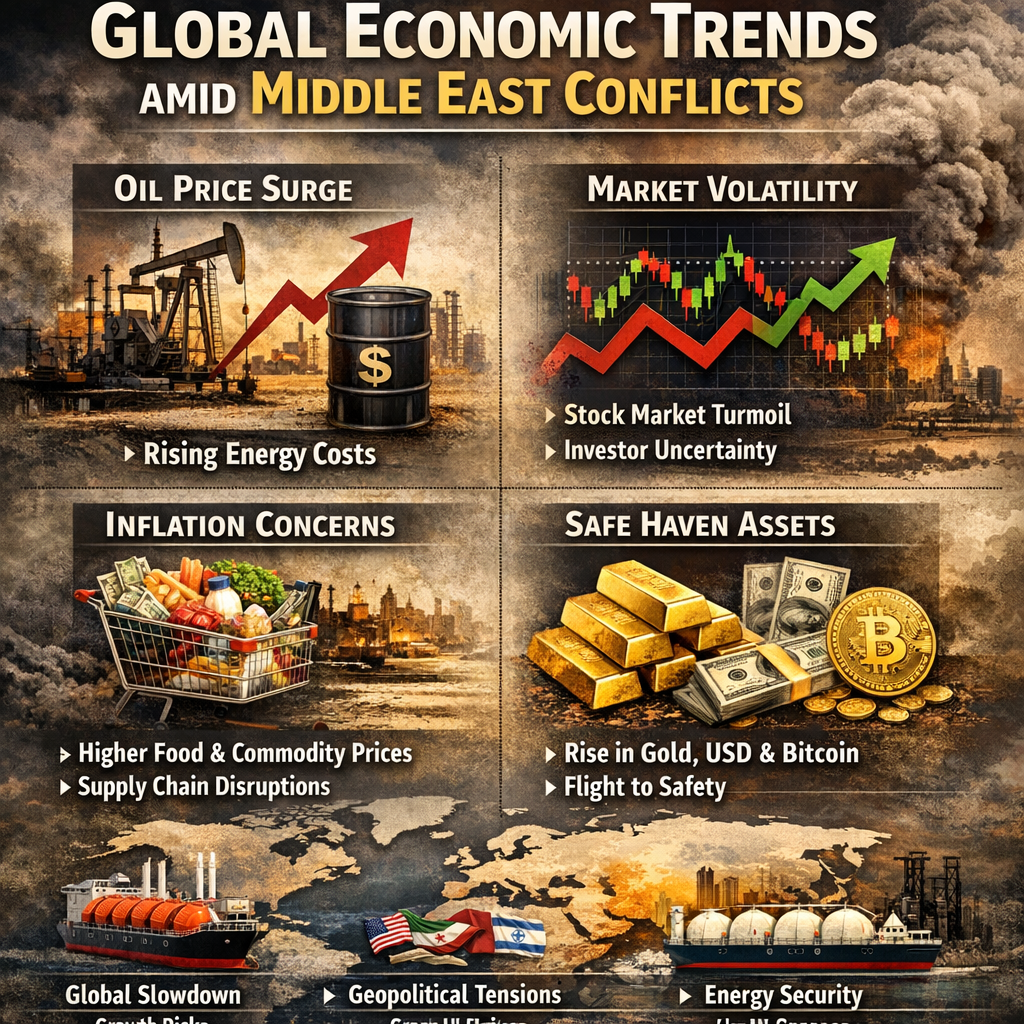
The global economic landscape is currently navigating a series of challenges, primarily influenced by escalating tensions in the Middle East. These developments have led to significant fluctuations in energy prices, subsequently affecting inflation rates and economic growth across various regions.
Impact of Middle East Conflicts on Global Economy
Recent conflicts in the Middle East have disrupted energy production and trade, leading to an energy shock that has intensified inflationary pressures worldwide. The Organization for Economic Cooperation and Development (OECD) projects global growth to slow to 2.8% in 2026, down from 3.4% in 2025, with a potential rebound to 3.1% in 2027. This outlook is contingent upon the duration and resolution of the ongoing conflicts.
Regional Economic Projections
In the United States, growth is anticipated to reach 2.0% in 2026, before moderating to 1.8% in 2027. The euro area is expected to experience modest growth of 0.8% in 2026, improving to 1.2% in 2027. China’s growth is projected to slow to 4.5% in 2026 and 4.3% in 2027.
Inflationary Trends and Monetary Policies
The energy shock has led to higher commodity prices, with consumer price inflation in G20 economies expected to rise to 4.0% in 2026, up from 3.4% in 2025. In response, central banks are adopting cautious monetary policies. The Federal Reserve, under new Chair Kevin Warsh, has maintained the federal funds rate at 3.5% to 3.75%, emphasizing a data-dependent approach to future rate adjustments.
Trade Dynamics and Policy Shifts
The European Union is increasingly concerned about a potential surge of inexpensive Chinese exports, which could adversely affect key industries. This apprehension is shaping current EU trade policies, especially as China’s trade surplus reached a record $1.2 trillion last year. European policymakers are aligning with the U.S. perspective that China’s industrial overproduction poses a significant threat to domestic manufacturing.
Conclusion
As the global economy contends with the repercussions of Middle East conflicts, energy shocks, and shifting trade dynamics, policymakers and investors must remain vigilant. Adapting to these evolving challenges is crucial for sustaining economic stability and growth in the coming years.