

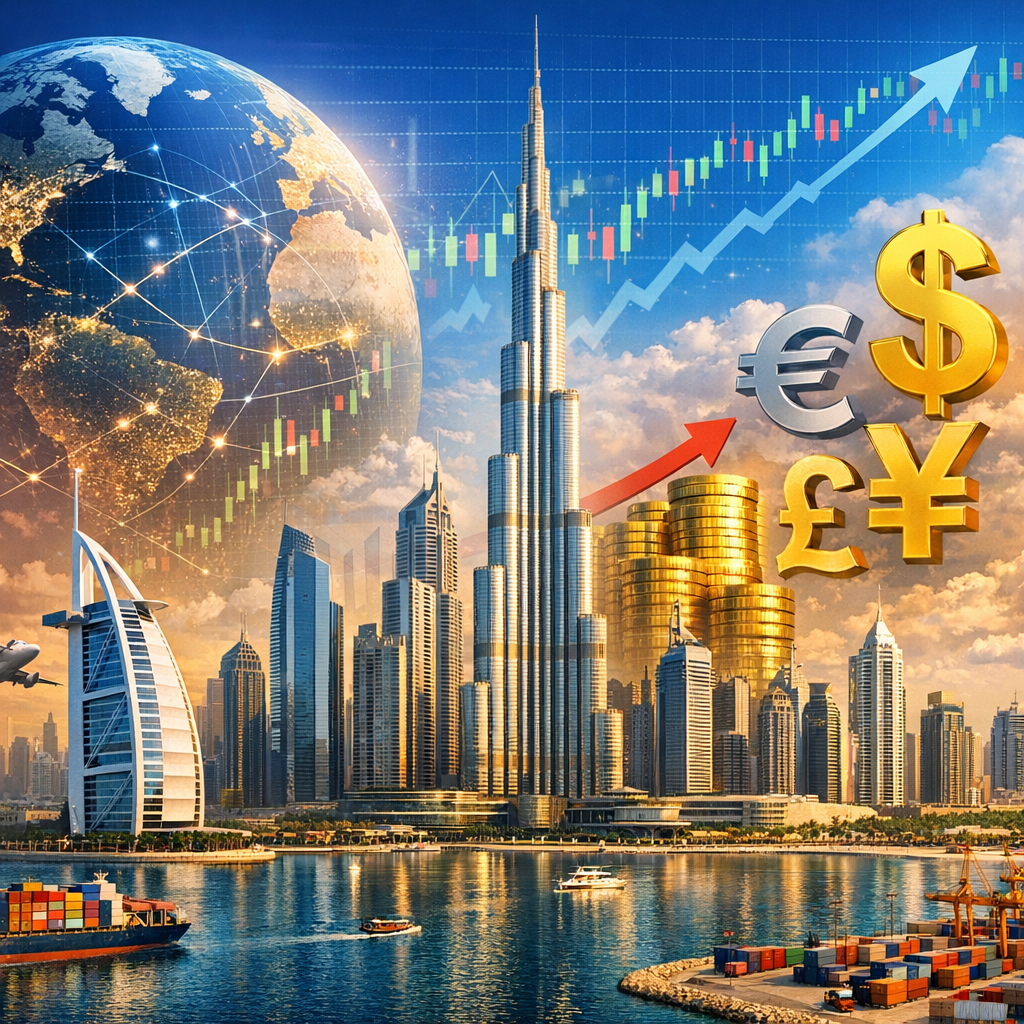
As the global economy faces a complex interplay of challenges and opportunities, Dubai’s strategic position necessitates a nuanced understanding of these dynamics to sustain its economic resilience.
Global Economic Landscape
Recent forecasts indicate a moderation in global economic growth. The International Monetary Fund (IMF) projects a global growth rate of 3% for this year, a slight decrease from the previous year’s 3.5%. This slowdown is attributed to factors such as geopolitical tensions and energy market disruptions. Concurrently, the Organization for Economic Cooperation and Development (OECD) anticipates a growth rate of 2.9%, highlighting the impact of energy shocks and rising inflationary pressures.
Energy Market Volatility
The ongoing conflict in the Middle East has led to significant disruptions in energy production and trade, particularly affecting Gulf economies. The closure of the Strait of Hormuz has resulted in a substantial increase in oil prices, contributing to global inflationary pressures. The OECD outlines two scenarios: a time-limited disruption with a gradual return to pre-conflict energy levels, and a prolonged disruption scenario with extended energy market instability.
Technological Advancements
Despite these challenges, technological investments, especially in artificial intelligence (AI), are providing a counterbalance. Increased AI-driven investments are bolstering economic activity, particularly in sectors like data centers and digital infrastructure. This trend underscores the importance of technological innovation in mitigating economic downturns.
Implications for Dubai
Dubai’s economy, deeply integrated into global trade and energy markets, is directly influenced by these global trends. The energy market volatility poses challenges, given the emirate’s role as a regional trade hub. However, Dubai’s proactive investment in technology and infrastructure positions it to leverage the benefits of the global shift towards AI and digitalization.
To navigate these global economic shifts, Dubai may consider:
- Diversifying Energy Sources: Reducing reliance on traditional energy imports by investing in renewable energy projects and alternative energy sources.
- Enhancing Technological Infrastructure: Continuing to invest in AI and digital technologies to drive economic growth and attract global tech investments.
- Strengthening Trade Partnerships: Expanding trade relations with emerging markets to mitigate the impact of regional geopolitical tensions.
By adopting these strategies, Dubai can bolster its economic resilience and continue to thrive amidst the evolving global economic landscape.