

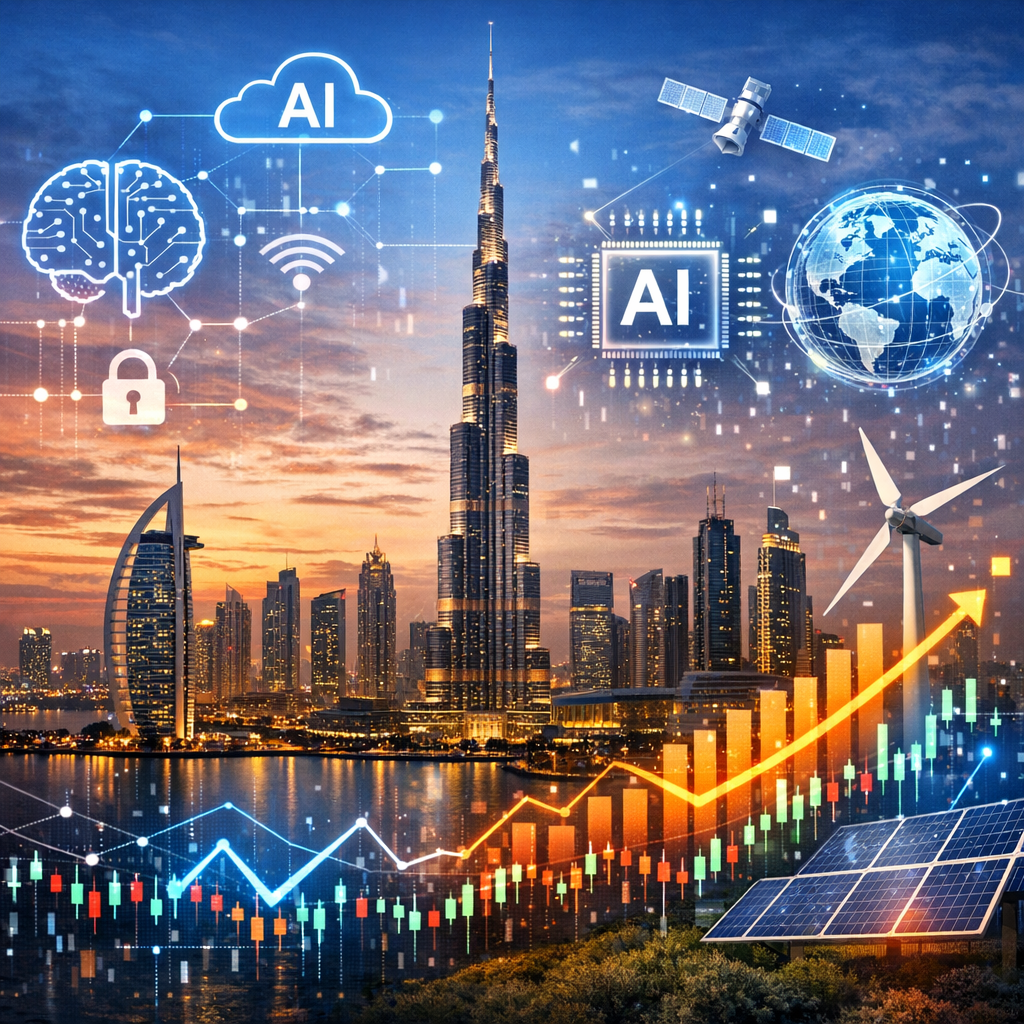
As the global economy undergoes significant transformations, Dubai stands at a pivotal juncture, poised to adapt and thrive amidst these changes. Key global trends, notably the surge in artificial intelligence (AI) investments and fluctuations in energy markets, are reshaping economic landscapes worldwide, with direct implications for our city.
Global Economic Trends
Recent analyses indicate a moderate global growth trajectory, with projections suggesting a slowdown to 2.7% in 2026, influenced by subdued investment and structural challenges. This deceleration underscores the need for economies to diversify and innovate to maintain resilience.
Concurrently, the AI sector is experiencing unprecedented investment levels. Gartner’s revised forecast anticipates a 14.2% annual increase in global IT spending by 2026, reaching $6.37 trillion, primarily driven by AI-related infrastructure developments. This surge is expected to bolster sectors such as data centers and Infrastructure as a Service (IaaS), highlighting the transformative potential of AI across industries.
Energy Market Dynamics
The energy sector remains a focal point of global economic discourse. The ongoing conflict in the Middle East has disrupted oil exports, leading to elevated commodity prices and inflationary pressures. Projections suggest global inflation could reach approximately 4.5%, with growth potentially slowing to 2.8% as a result. These developments necessitate strategic responses from economies heavily reliant on energy markets.
Implications for Dubai
Dubai’s strategic position as a global trade and business hub necessitates a proactive approach to these global shifts. The city’s commitment to technological innovation aligns with the global emphasis on AI, presenting opportunities for economic diversification and growth. By investing in AI and related technologies, Dubai can enhance its competitive edge and attract international partnerships.
Moreover, the volatility in energy markets underscores the importance of Dubai’s ongoing efforts to diversify its energy sources and invest in sustainable alternatives. Strengthening energy resilience will mitigate the impact of global market fluctuations and support long-term economic stability.
Conclusion
In an era of rapid global economic change, Dubai’s adaptability and forward-thinking strategies are crucial. By embracing technological advancements and reinforcing energy resilience, the city can navigate these challenges effectively, ensuring sustained growth and prosperity for its residents and businesses.