

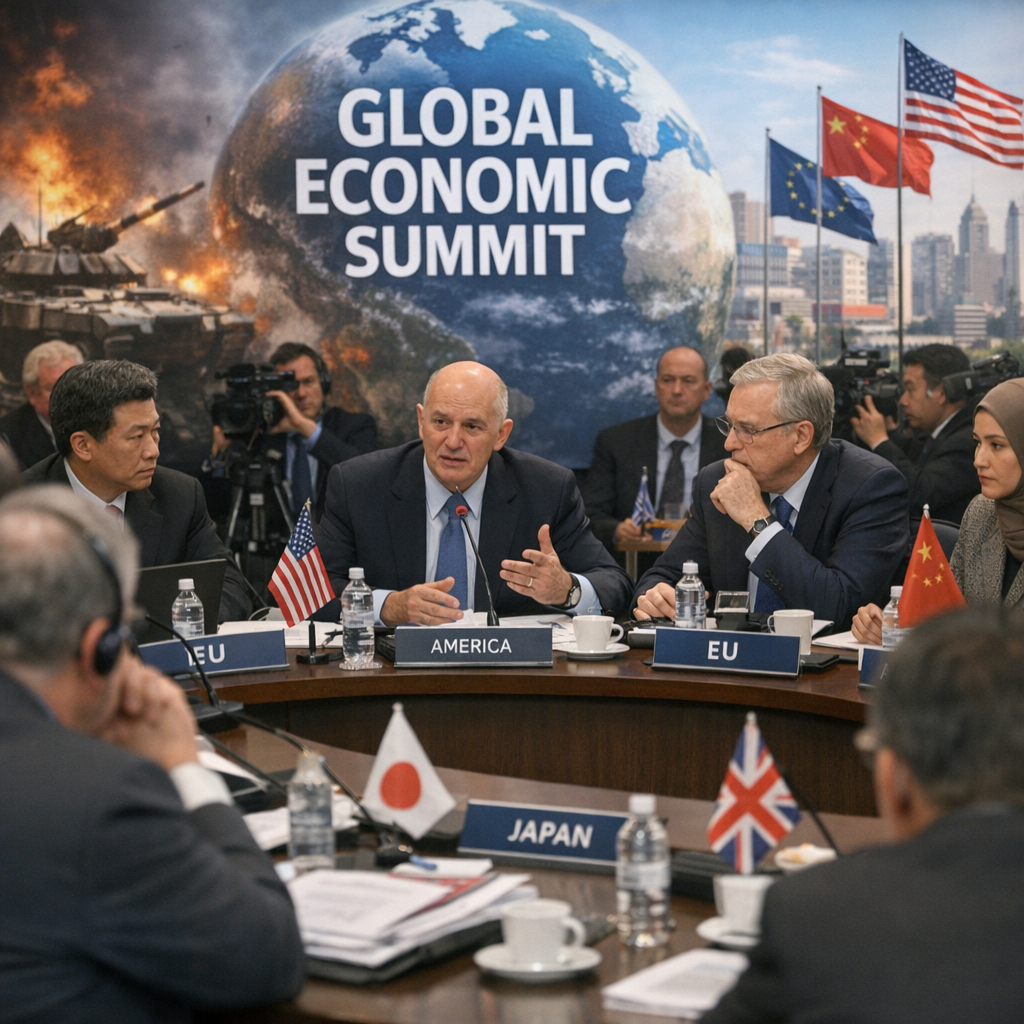
The global economy is currently navigating a complex landscape shaped by geopolitical tensions and energy market disruptions. Recent conflicts in the Middle East have introduced significant uncertainties, influencing economic growth and inflation worldwide.
Impact of Middle East Conflicts on Global Growth
The Organization for Economic Cooperation and Development (OECD) has highlighted that the evolving conflict in the Middle East is a dominant force affecting global economic prospects. This situation has led to an energy shock, driving inflationary pressures and adversely impacting growth. The OECD projects global growth to slow from 3.4% in 2025 to 2.8% in 2026, with a potential rebound to 3.1% in 2027, assuming a resolution to the conflict. However, a prolonged disruption could further reduce growth prospects, with global growth potentially slowing to 2.1% in 2026 and 1.8% in 2027.
Inflationary Pressures and Energy Market Disruptions
Inflationary pressures are rising in both advanced and emerging market economies, primarily due to the energy shock stemming from the Middle East conflict. This has led to higher commodity prices and increased costs across various sectors. In the OECD’s time-limited disruption scenario, annual consumer price inflation in G20 economies is expected to rise to 4.0% in 2026, up from 3.4% in 2025, before easing to 3.1% in 2027 as energy and food price pressures subside. A prolonged disruption scenario would result in even higher inflation rates.
Regional Economic Outlooks
Different regions are experiencing varied economic impacts:
- United States: GDP growth is projected at 2.0% in 2026, before slowing to 1.8% in 2027.
- Euro Area: Growth is projected to remain modest at 0.8% in 2026, picking up to 1.2% in 2027.
- China: Growth is projected to slow to 4.5% in 2026 and 4.3% in 2027.
These projections underscore the widespread impact of geopolitical tensions on global economic performance.
Policy Recommendations
In response to these challenges, the OECD recommends that fiscal support provided by countries should be targeted towards those most in need and be temporary to avoid further increases in public debt and to preserve incentives to save energy. Additionally, countries are encouraged to diversify energy supply sources and improve energy efficiency to reduce vulnerabilities to future shocks.
As the global economic landscape continues to evolve, staying informed about these developments is crucial for policymakers, businesses, and individuals alike.