

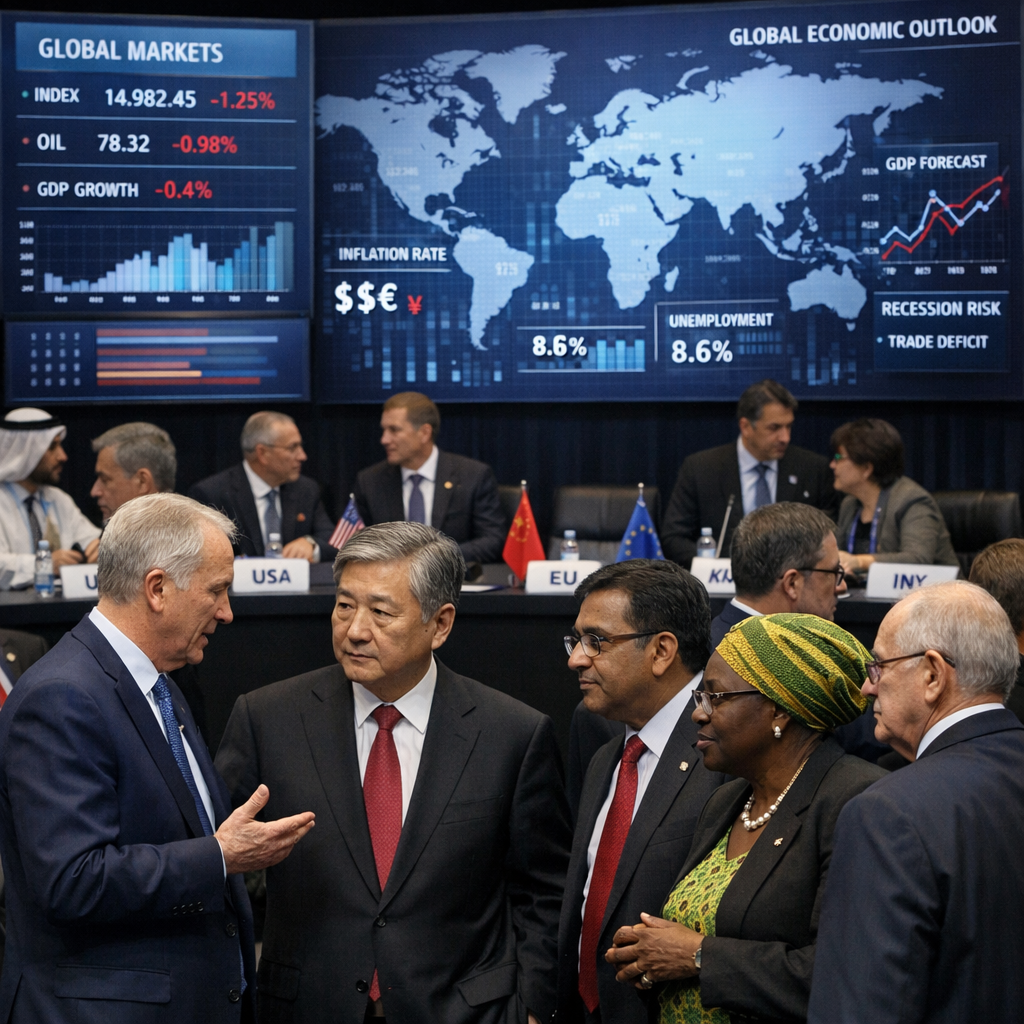
The global economy is currently navigating a complex landscape shaped by geopolitical tensions and rapid technological advancements. Recent conflicts, particularly in the Middle East, have introduced significant uncertainties, while the accelerated adoption of artificial intelligence (AI) is transforming various sectors.
Geopolitical Tensions and Economic Impacts
The ongoing conflict in the Middle East has led to disruptions in energy supplies, notably due to the closure of the Strait of Hormuz, a critical chokepoint for global oil transportation. This has resulted in a substantial increase in oil prices, contributing to inflationary pressures worldwide. The International Monetary Fund (IMF) has adjusted its global growth forecast for 2026 to 3%, down from the previous estimate of 3.1%, citing the economic repercussions of these geopolitical developments.
Technological Advancements and Economic Resilience
Amid these challenges, technological advancements, particularly in AI, are providing a counterbalance. Increased investment in AI and related technologies is fostering productivity gains and economic resilience. The United States, for instance, is projected to experience a growth rate of 2.3% in 2026, bolstered by AI-driven productivity and a robust stock market.
Regional Economic Outlooks
Different regions are experiencing varied economic trajectories. The eurozone faces slower growth, projected at 0.9% in 2026, primarily due to energy challenges. China anticipates a growth rate of 4.6%, influenced by property market issues but supported by infrastructure investments and technology exports. India remains a bright spot, with an expected growth rate of 6.4%, driven by strong consumer demand.
Policy Responses and Future Prospects
In response to these dynamics, policymakers are focusing on measures to stabilize economies. Central banks are navigating the delicate balance between controlling inflation and supporting growth. The Organization for Economic Cooperation and Development (OECD) emphasizes the importance of timely and targeted fiscal support, diversification of energy sources, and promotion of eco-friendly energy to enhance economic resilience.
As the global economy continues to evolve amidst these challenges and opportunities, staying informed and adaptable is crucial for businesses and individuals alike.