

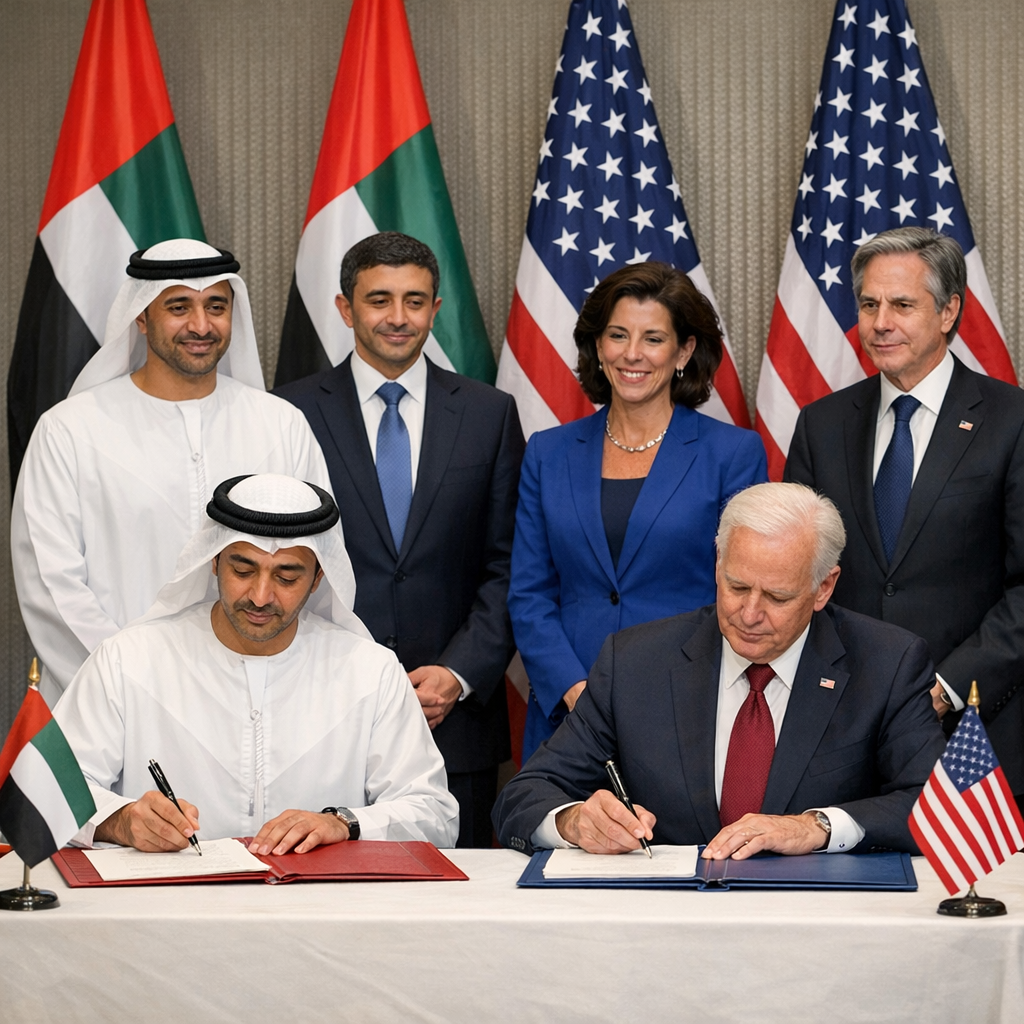
The United Arab Emirates (UAE) and the United States have long maintained a robust economic partnership, characterized by significant trade and investment flows. In recent years, this relationship has reached new heights, underscoring the mutual benefits derived from their collaboration.
Record-Breaking Trade Figures
In 2025, bilateral trade between the UAE and the U.S. soared to an unprecedented $39 billion. This milestone marks the 17th consecutive year that the UAE has been the top export destination for U.S. goods and services in the Middle East and North Africa region. U.S. exports to the UAE totaled $31.4 billion, reflecting a 16% increase from the previous year. This surge contributed to a U.S. trade surplus of $23.8 billion with the UAE, the fourth largest globally. Such figures highlight the deepening economic ties and the UAE’s pivotal role in supporting American jobs and industries.
Substantial Investments and Future Commitments
The UAE’s commitment to the U.S. economy extends beyond trade. Emirati investments in the U.S. have surpassed $1 trillion, with plans to invest an additional $1.4 trillion over the next decade. These investments span various sectors, including aerospace, energy, manufacturing, technology, life sciences, and healthcare. This strategic allocation of resources underscores the UAE’s confidence in the U.S. market and its dedication to fostering innovation and economic growth.
Political Dynamics and Regional Implications
While economic relations flourish, the political landscape presents challenges. Recent developments, such as the preliminary agreement between the U.S. and Iran to extend a ceasefire, aim to end a protracted conflict that has caused regional instability and global energy disruptions. The agreement includes reopening the Strait of Hormuz, a critical passage for global shipping. However, the deal’s fragility is evident, with Israel expressing skepticism and continuing military operations against Hezbollah in Lebanon. These actions complicate the broader geopolitical environment, affecting regional partners, including the UAE.
Furthermore, the U.S. military buildup in the Middle East, including the deployment of additional aircraft carriers, reflects ongoing tensions and the complex nature of regional security. Such developments necessitate careful navigation by the UAE to maintain its strategic partnerships while ensuring regional stability.
Conclusion
The UAE and the U.S. continue to strengthen their economic ties, achieving record trade figures and substantial investment commitments. However, the evolving political dynamics in the Middle East require both nations to collaborate closely, balancing economic interests with the pursuit of regional stability and security.