

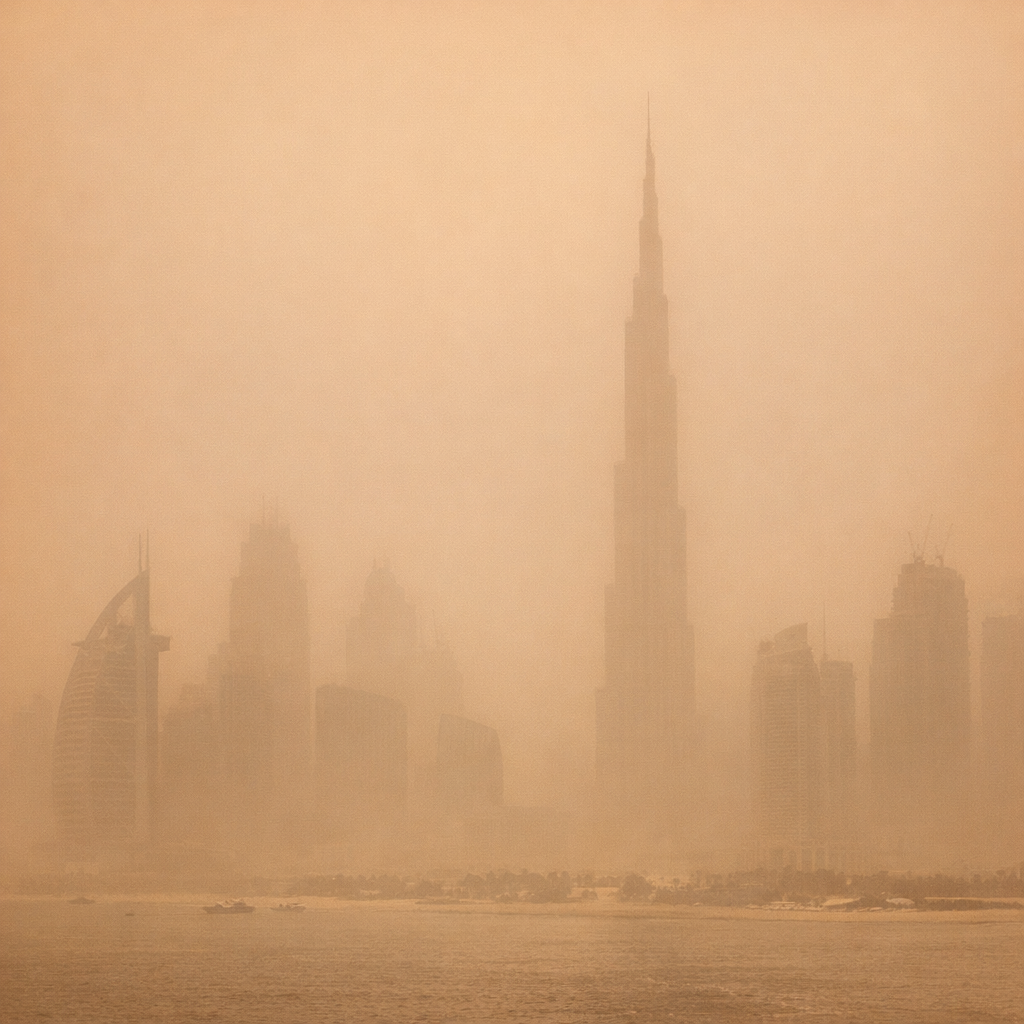
Dubai’s climate is characterized by its hot desert environment, featuring scorching summers and mild winters. Understanding these patterns is essential for residents and visitors alike.
Seasonal Weather Patterns
Summer (June to September)
During summer, temperatures often exceed 40°C, with humidity levels reaching 80–90% near the coast, creating a challenging combination of heat and moisture. The wet-bulb temperature—a measure of combined heat and humidity—occasionally approaches the human survivability limit of 35°C, making outdoor activity dangerous.
Winter (December to February)
Winters are mild, with daytime temperatures ranging from 20°C to 26°C and cooler nights. This period also brings the majority of the annual rainfall, averaging around 100 mm, primarily between December and March.
Environmental Challenges
Sandstorms
Dubai experiences sandstorms, particularly during the summer months. These are driven by strong north-westerly shamal winds that can reduce visibility quickly. Some years are dustier than others, with notable events logged across 2008, 2010, 2015, 2019, and 2022.
Air Quality
Air pollution is a concern, with the UAE being the 11th most polluted country globally based on PM2.5 concentrations. Major pollutants include particulate matter and nitrous oxides, primarily from fossil fuel combustion.
Adaptation and Mitigation Efforts
Dubai is actively addressing these environmental challenges through initiatives like the Tasreef storm-water program, a multibillion-dirham network expansion designed for next-century storms after 2024’s floods. Additionally, the Dubai 2040 Urban Master Plan aims to build 20-minute cities with shaded, walkable districts, heat-aware street design, and easier access to daily needs without long car trips.
Understanding Dubai’s climate and ongoing environmental efforts is crucial for adapting to its unique conditions and contributing to a sustainable future.